
7 Warning Signs of Gum Disease You Should Never Ignore
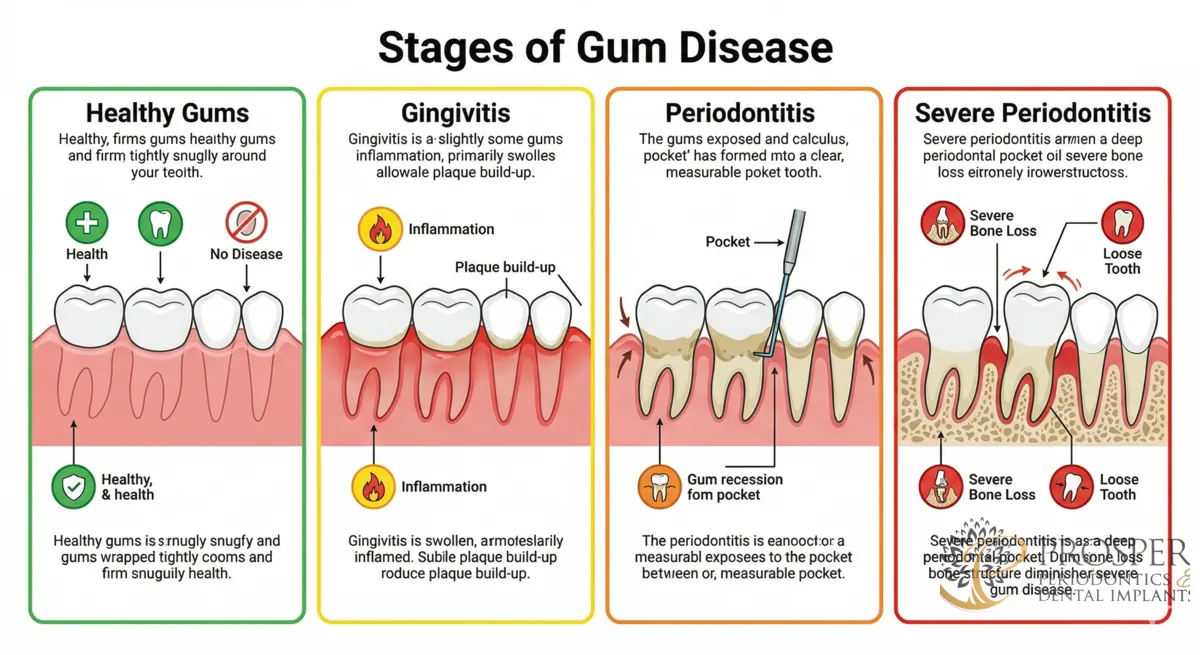
How Do You Know If You Have Gum Disease?
Gum disease often develops silently, without pain, which is why most people do not realize they have it until significant damage has occurred. According to the CDC, nearly half of American adults over 30 have some form of periodontal disease. Recognizing the early warning signs can save your teeth and prevent serious health complications.
1. Bleeding Gums When Brushing or Flossing
Healthy gums do not bleed. If you see pink in the sink after brushing, this is the earliest and most common sign of gingivitis — the first stage of gum disease. Many people dismiss this as “normal,” but it is your body signaling that bacterial infection is irritating the gum tissue.
2. Red, Swollen, or Tender Gums
Healthy gums are firm and pale pink. Gums that appear dark red, puffy, or feel sore to the touch indicate active inflammation. This inflammation is your immune system fighting the bacteria that have colonized below the gumline.
3. Persistent Bad Breath (Halitosis)
Chronic bad breath that does not improve with brushing or mouthwash is often caused by bacteria trapped in deep periodontal pockets. These pockets form as gum disease progresses and create an environment where odor-causing bacteria thrive.
4. Receding Gums
If your teeth appear longer than they used to, or you can see the yellowish root surface, your gums are receding. Gum recession exposes the sensitive root, increases cavity risk, and worsens without treatment.
5. Loose or Shifting Teeth
Adult teeth should not feel loose or change position. If you notice movement, gaps forming between teeth, or a change in your bite, the bone supporting your teeth is being destroyed by advanced periodontitis. This requires immediate professional treatment.
6. Pain When Chewing
Discomfort or pain while eating can indicate that the supporting structures around your teeth are compromised. This may be caused by deep periodontal pockets, gum abscesses, or weakened bone support.
7. Pus Between Teeth and Gums
Pus or discharge from the gums is a sign of active infection and requires urgent periodontal care. This indicates a periodontal abscess, which can spread to other areas if untreated.
What Should You Do If You Notice These Signs?
If you are experiencing one or more of these symptoms, schedule an appointment with a periodontist as soon as possible. Early-stage gum disease (gingivitis) is fully reversible. Even moderate to advanced periodontitis can be successfully treated with procedures like LANAP laser gum treatment, which regenerates lost bone without surgery.
Dr. Parachuru at Prosper Periodontics provides comprehensive gum disease evaluation and treatment for patients in Prosper, Celina, Frisco, and McKinney. Call (972) 787-1122 or book online.
Why Do So Many People Miss the Early Warning Signs of Gum Disease?
Gum disease is uniquely good at staying hidden. Unlike a cavity, which eventually causes pain, early and even moderate periodontitis often progresses without any discomfort. The infection operates below the gumline, in pockets that patients cannot see or feel. By the time symptoms become obvious – loose teeth, visible gum recession, persistent bad breath – the disease has frequently been active for months or years.
The silence of gum disease is made worse by a common misinterpretation of the warning signs. Bleeding gums, for example, are widely dismissed as a normal response to brushing too hard. Gum recession gets attributed to aging. Bad breath is blamed on diet. Each of these explanations feels plausible, which is why patients wait – and why nearly half of American adults over 30 have some form of periodontal disease according to CDC data, yet most are not actively being treated for it.
Understanding what each warning sign actually means – and why it should not be ignored – is the first step toward getting ahead of the disease before it causes irreversible damage.
What Does Bleeding When You Brush Actually Mean?
Bleeding gums are not a sign that you are brushing too hard – they are a sign that your gums are infected. Healthy gum tissue has a dense, tightly organized structure that does not bleed under normal mechanical force. When bacteria colonize the gumline, they trigger an inflammatory response that makes the tissue fragile, engorged with blood vessels, and highly reactive to even gentle contact.
The key diagnostic point is frequency and location. If brushing your lower front teeth – one of the easiest areas to clean in your mouth – still causes bleeding, that is not about technique. That is infection. The gum tissue is inflamed because the bacterial biofilm has not been adequately disrupted day after day. In contrast, occasional bleeding when you have been sick and skipped flossing for a week is far less concerning than consistent bleeding every single morning.
Early-stage bleeding (gingivitis) can be fully resolved with proper professional cleaning and improved home care. The key is acting on it rather than waiting. Patients who see bleeding gums and immediately schedule a periodontal evaluation catch gum disease at its only truly reversible stage. Patients who wait until the bleeding gets worse or is accompanied by other symptoms often find themselves dealing with bone loss that cannot be undone.
Clinical Evidence
Absence of bleeding on probing during supportive periodontal therapy is a reliable indicator of periodontal stability, while consistent bleeding sites predict future attachment loss if left untreated. — Journal of Periodontology (Lang et al., 1986)
How Can You Tell the Difference Between Normal Gum Recession and Disease-Related Recession?
Not all gum recession has the same cause, and the distinction matters for treatment. Recession falls into two primary categories: recession caused by periodontal disease (from bone loss underneath the gums) and recession caused by traumatic brushing, gum thinness, or tooth position without significant bone loss. Both types require professional evaluation, but they are treated differently.
Disease-related recession typically presents with additional findings. The teeth in the affected area often have deeper pockets when probed. X-rays show bone loss adjacent to the receded area. The gums may be inflamed or bleed on probing. This pattern indicates that the recession is the surface manifestation of a deeper problem – the bone is being destroyed from the infection, and the gum follows the bone level downward.
Traumatic recession often presents in isolation. A single tooth or a small group of teeth shows recession with minimal pocket depth, no bleeding, and healthy bone levels on X-ray. This pattern is more commonly seen on lower front teeth in patients who brush vigorously, on teeth that are positioned outside the normal arch, or in patients with naturally thin gum tissue.
Both types of recession can be addressed with gum grafting procedures. However, disease-related recession must have the underlying periodontitis treated and stabilized before grafting – adding new tissue over an active infection leads to predictable failure. The sequence matters: treat the infection first, then restore the tissue. This is standard protocol at Prosper Periodontics and is one reason a thorough diagnosis before any grafting procedure is non-negotiable.
When Does Bad Breath Signal a Serious Gum Problem?
Distinguishing ordinary bad breath from periodontal-related halitosis requires attention to pattern, not just presence. Transient bad breath from food, coffee, or morning is common and not medically significant. Chronic bad breath that persists despite thorough brushing, flossing, tongue scraping, and the use of mouthwash – particularly if it has been present for months – is a different clinical situation entirely.
The source of periodontal halitosis is specific. Gram-negative anaerobic bacteria living in deep periodontal pockets produce volatile sulfur compounds (VSCs) – primarily hydrogen sulfide and methyl mercaptan – as metabolic byproducts. These compounds have an intensely unpleasant odor and are chemically stable, meaning they are not neutralized by surface-level hygiene. A mouthwash masks the smell temporarily but does nothing to address the bacterial colony 5 to 7mm below the gumline producing the odor.
Patients with periodontal halitosis frequently report that their breath is noticeably worse in the morning, immediately after cleaning, or when they are under stress or ill. This pattern reflects the bacterial lifecycle in pockets – overnight with reduced saliva flow, bacteria proliferate and VSC production increases. This is a reliable clinical indicator that something deeper than surface hygiene is driving the problem.
If you have addressed every other possible cause of bad breath without improvement, a comprehensive periodontal evaluation is the appropriate next step. A periodontist can measure pocket depths, identify the bacterial load, and determine whether active gum disease is the source. Effective treatment eliminates the pocket environment where VSC-producing bacteria thrive, typically resolving periodontal halitosis within weeks of successful therapy.
Expert Insight
“I see patients every week who have been to three dentists and tried every mouthwash on the market without solving their bad breath problem. When I probe their teeth and find 6- and 7-millimeter pockets full of anaerobic bacteria, the source becomes obvious. No amount of surface cleaning reaches those pockets. Until we treat the infection, the problem will not go away - because we are not addressing where the problem actually lives.”
— Dr. Parachuru, Periodontist
What Happens If You Ignore the Warning Signs of Gum Disease?
Untreated gum disease follows a predictable and worsening trajectory. The timeline varies by patient – some people progress slowly over years, while others with genetic susceptibility or systemic health factors lose bone rapidly. But the direction is always the same without intervention: deeper pockets, more bone loss, increasing tooth mobility, and eventually tooth loss.
The consequences extend beyond the mouth. Chronic periodontal infection is a significant source of systemic inflammation. Research has established clear links between untreated periodontitis and elevated cardiovascular disease risk, impaired blood sugar control in diabetic patients, and increased risk of Alzheimer’s disease. The bacteria causing gum disease – particularly Porphyromonas gingivalis – have been found in arterial plaques, brain tissue, and the spinal fluid of patients with cardiovascular and neurodegenerative disease. Learn more about how untreated gum disease affects the rest of your body in our article on the link between gum disease and heart disease, diabetes, and Alzheimer’s.
Tooth loss from advanced periodontitis carries its own serious consequences. When teeth are lost, the jawbone that supported those roots begins to resorb. Within the first year after tooth loss, 25 percent of the bone width in that area is gone. Over 5 years, significant volumetric bone loss occurs. This bone loss complicates future dental implant placement, affects facial structure, and in cases of multiple tooth loss, changes the way a patient bites, chews, and speaks.
The financial cost of ignoring early warning signs also compounds dramatically. A professional cleaning and improved home care to resolve gingivitis might cost a few hundred dollars. Treating advanced periodontitis with laser therapy or surgery, followed by implants to replace teeth that could not be saved, can cost tens of thousands of dollars. The disease is far cheaper – and far easier – to treat early.
How Is Gum Disease Diagnosed at a Periodontal Evaluation?
A comprehensive periodontal examination gives your periodontist a precise, objective measurement of exactly where your gum disease stands. This is not a judgment call – it is a clinical assessment built on quantifiable data points that can be compared at every future visit to track stability or progression.
The cornerstone of periodontal diagnosis is pocket depth charting. Using a thin, calibrated probe, your periodontist gently measures the depth of the sulcus – the groove between your gum and tooth – at six sites around every tooth. Healthy sulcus depth is 1 to 3mm. Readings of 4mm indicate early disease. Readings of 5 to 6mm indicate moderate periodontitis. Readings of 7mm or above indicate advanced disease requiring active treatment. These numbers are recorded for every tooth, giving a complete map of disease distribution and severity.
Bleeding on probing is recorded simultaneously. Healthy tissue does not bleed when probed. The percentage of sites that bleed gives a systemic picture of disease activity across the entire mouth and serves as a benchmark for measuring treatment response at follow-up appointments.
Digital X-rays – and in complex cases, 3D CBCT imaging – complete the diagnostic picture. While probing measures the soft tissue, X-rays reveal the bone support underneath. They show where bone loss has already occurred, how severe it is, whether bone loss is horizontal or has created angular defects that may be candidates for regenerative treatment, and whether any teeth have root anatomy that affects treatment planning.
If you are experiencing any of the 7 warning signs discussed in this article, the most important step you can take right now is to schedule a periodontal evaluation. At Prosper Periodontics, Dr. Parachuru provides a complete diagnosis and treatment plan at your first visit. You will leave knowing exactly what stage your disease is at, what treatment is recommended, what the realistic outcomes are, and what the full cost picture looks like. Learn whether your condition is still reversible and explore LANAP laser treatment as a minimally invasive option if active periodontitis is present.
Clinical Evidence
The 1999 classification system for periodontal diseases, validated through multiple subsequent studies, demonstrates that periodontal pocket depth combined with radiographic bone levels and clinical attachment loss provides the most reliable staging framework for treatment planning and outcome prediction. — Journal of Periodontology (Armitage, 1999)
Related Resources
Learn more about the services and topics discussed in this article:
- periodontal care
- LANAP laser treatment
- oral cancer screenings
- reversing gum disease
- gum disease and systemic health
Serving Prosper, TX and Surrounding Communities
Prosper Periodontics and Dental Implants proudly serves patients across North Dallas, including: periodontal care in Frisco, TX. Schedule your appointment today.