
All-on-4 Dental Implants: The Complete Guide

If you are facing the loss of most or all of your teeth in an arch, the choice between conventional dentures and a fixed implant solution is one of the most consequential dental decisions you will make. All-on-4 dental implants have emerged over the past two decades as the predictable, evidence-based answer for full-arch rehabilitation. This guide walks you through how the procedure actually works, what makes someone a candidate, what the costs and timelines look like, and how to think about long-term value. Dr. Praveen Parachuru places All-on-4 cases at Prosper Periodontics with the same protocol used in the original Malo Clinic studies.
How Do All-on-4 Dental Implants Work?
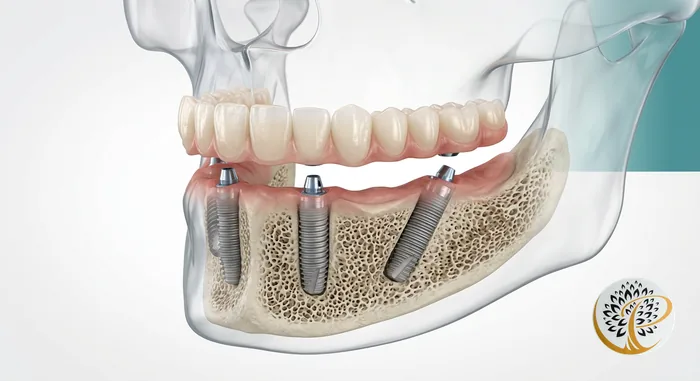
All-on-4 dental implants restore an entire arch of teeth using just four titanium posts strategically angled into the densest available bone. The protocol was developed by Portuguese implant surgeon Paulo Malo in the late 1990s and has accumulated more than two decades of peer-reviewed clinical data since then. The genius of the design lies in the angulation: the two front implants are placed vertically, while the two posterior implants are tilted at 30 to 45 degrees. That tilt accomplishes two things at once. It allows longer implants to engage denser cortical bone, and it bypasses the maxillary sinus and the inferior alveolar nerve canal that would otherwise complicate placement in patients with significant posterior bone loss.
Once the four implants are placed, a cross-arch prosthesis is screw-retained directly onto them. This prosthesis is a single unit that replaces 10 to 14 teeth, depending on the arch and patient anatomy. Because the implants distribute biting forces across the full length of the jaw, four well-placed implants can support the same prosthesis that traditional protocols would require six or eight implants to support. That efficiency is what reduces surgical time, eliminates most bone grafting, and keeps the procedure within reach for patients who were previously told they had insufficient bone for implants.
The process is sometimes called “Teeth in a Day” because patients leave the surgical appointment with a fixed temporary prosthesis already in place. You arrive without functioning teeth and leave with a full arch of teeth that look natural and let you eat softer foods that same evening.
Who Is a Candidate for All-on-4 Implants?
All-on-4 is designed for patients who have lost all the teeth in an arch, are about to lose them due to advanced periodontal disease, or are unhappy with conventional dentures and want a fixed solution. Candidacy evaluation focuses on three factors: bone, periodontal status, and overall health.
Bone volume is assessed using a 3D cone beam CT scan. Because the posterior implants are angled, All-on-4 succeeds in many cases where vertical implants would require sinus lifts or extensive grafting. That said, some minimum bone volume in the front of the jaw is still required to anchor the four implants. The CBCT scan determines this conclusively, and Dr. Parachuru reviews the imaging with each patient before treatment planning.
Periodontal health matters because active gum disease compromises the bone around any future implants. Patients transitioning from failing natural teeth to All-on-4 receive a coordinated extraction and placement plan that addresses every infection site at the same surgical visit. Treating periodontal disease is not a delay in care. It is what separates a successful long-term outcome from an implant placed into a compromised foundation.
Systemic health follows the same criteria as single-tooth implants. Well-controlled diabetes, managed cardiovascular conditions, and a non-smoking status all support favorable outcomes. Heavy smokers face implant failure rates two to three times higher than non-smokers, and Dr. Parachuru will have a direct conversation about cessation before proceeding. Patients on bisphosphonates for osteoporosis or undergoing active radiation therapy to the head and neck require additional medical coordination. For a deeper look at who qualifies, see our companion guide on whether dental implants are worth it.
What Does the All-on-4 Procedure Look Like Step by Step?
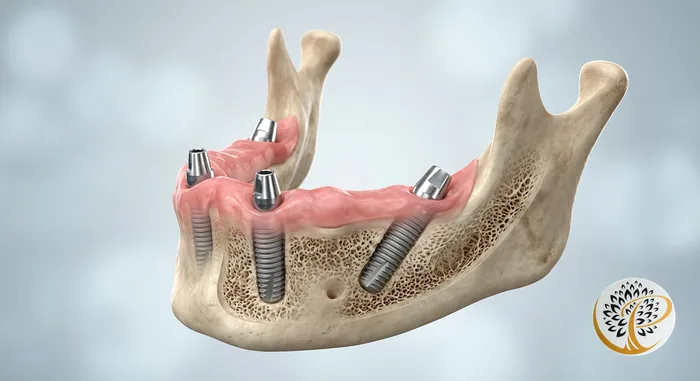
The All-on-4 process unfolds across three phases over four to six months, with the patient leaving day one with a working set of teeth. Understanding the timeline reduces anxiety and makes it easier to plan around work and life commitments.
Phase one is the consultation and digital planning visit. A 3D CBCT scan maps available bone, locates the inferior alveolar nerve, identifies sinus boundaries, and determines optimal implant angulation. Digital impressions and a clinical exam complete the workup. Dr. Parachuru uses guided surgery software to plan each implant position to within fractions of a millimeter before any incision is made. This pre-surgical precision is what makes the same-day prosthesis possible.
Phase two is surgery day. After IV sedation is administered, any remaining failing teeth are extracted. The four implants are placed according to the digital plan, with the back two angled to maximize bone contact. The implants are torqued to a level that confirms primary stability. A fixed temporary prosthesis is then secured directly to the implants. The full appointment typically runs four to six hours. Most patients describe minimal awareness of the procedure due to sedation.
Phase three is osseointegration and the final prosthesis. Over the next four to six months, the titanium implants fuse to the surrounding bone through a biological process called osseointegration. The temporary prosthesis remains in place during this period and allows full function on a soft and softer-textured diet. Once osseointegration is verified, the final restoration is fabricated. Most patients receive a milled zirconia prosthesis for its combination of strength and lifelike esthetics. This final prosthesis is the one designed to last 15 to 20 years or more with proper care. For more detail on the healing window, our dental implant recovery guide walks through what to expect day by day.
How Much Do All-on-4 Dental Implants Cost?
All-on-4 typically ranges from $20,000 to $30,000 per arch in the Prosper area, with the final number depending on materials, sedation, and any preparatory work. That price includes the surgical placement of all four implants, IV sedation, the immediate temporary prosthesis, and the final milled zirconia restoration. It does not always include extractions of remaining teeth or treatment of active periodontal disease, which are billed separately when needed.
For context, a conventional upper and lower denture costs $1,000 to $3,000 per arch but is replaced or relined every five to eight years. Over 20 years, that adds up to $4,000 to $12,000 in repeat costs, plus thousands more in adhesive, soft liners, and managing the bone loss that conventional dentures accelerate. All-on-4 is a higher upfront investment that typically costs less per year of function once you factor in longevity and the avoided cost of progressive bone loss.
Most patients use Cherry Financing to spread the cost into manageable monthly payments. Cherry approves many applicants with as little as zero down and offers terms that fit a range of budgets. A complete pricing conversation, including how your dental insurance will apply, happens at the consultation visit. For a detailed regional cost breakdown, see our dental implant cost guide for Prosper, TX.
How Long Do All-on-4 Implants Last?
The titanium implants themselves are designed to last a lifetime, while the prosthesis attached to them typically functions for 15 to 20 years before replacement. The peer-reviewed literature is unusually consistent on this point. Implant survival rates of 94 to 98 percent at 10 years are reported across multiple long-term studies, with the mandible (lower jaw) generally outperforming the maxilla (upper jaw) due to denser bone. Prosthetic survival is slightly lower, primarily because the prosthesis itself can chip, the retention screws can loosen, or wear can accumulate over years of biting forces. These are manageable maintenance issues, not implant failures.
Three factors drive long-term success. The first is surgical technique. Implants placed by specialist periodontists and oral surgeons consistently outperform those placed by general dentists in comparative studies, largely because specialists are managing bone biology and tissue health every day. The second is patient health. Active smokers, patients with uncontrolled diabetes, and patients with untreated bruxism all face elevated complication rates. The third is professional maintenance. Patients who attend scheduled maintenance visits every six months and clean conscientiously at home achieve survival rates near the top of the published range. Patients who skip maintenance and develop peri-implantitis (infection around the implant) see rates closer to the lower bound. For a broader look at implant longevity across implant types, our dental implant lifespan guide covers what the data shows.
What Is Recovery Like After All-on-4 Surgery?
Most patients are back to light work within five to seven days, eating soft foods comfortably within two weeks, and on a near-normal diet by week six to eight. Recovery from All-on-4 is more involved than single-tooth implant recovery because four implants are placed simultaneously and any remaining teeth are typically extracted at the same visit. That said, the experience is consistently milder than patients anticipate.
The first 72 hours involve some swelling, which peaks at days two and three. Bruising can extend down the face and neck in some patients and fades over a week. Prescription pain management typically transitions to over-the-counter options within three to five days. A liquid diet for the first 48 to 72 hours, followed by a soft-food diet for six to eight weeks, protects the healing implants from disruptive biting forces while osseointegration begins. Patients are encouraged to walk and resume light activity early, but heavy exercise and lifting are paused for two weeks.
Hygiene during the healing period is straightforward but specific. The temporary prosthesis is cleaned with a water flosser, soft brush, and prescribed antimicrobial rinse. Maintenance visits at one week, four weeks, and three months allow Dr. Parachuru to verify healing, adjust the bite if needed, and catch any issues early. Many patients comment that the recovery was less disruptive than the years of declining function that preceded surgery. For comparison with denture-based options, our deeper All-on-4 vs dentures comparison walks through the daily differences.
How Does All-on-4 Compare to Other Tooth Replacement Options?
All-on-4 sits at the high end of the investment spectrum for full-arch replacement and delivers the highest functional and biological outcomes of any option short of placing six or eight individual implants per arch. Knowing where it fits relative to alternatives helps clarify the decision.
Conventional full dentures are the lowest-cost option upfront. They restore appearance, but they sit on the gum tissue and apply no mechanical load to the underlying bone. The result is progressive jawbone resorption, a fit that worsens over years, and biting force reduced to roughly 25 percent of natural teeth. Many patients tolerate dentures for years before deciding the limitations are no longer acceptable.
Implant-retained overdentures use two to four implants to snap a removable denture into place. They are more stable than conventional dentures but still removable, still partially gum-borne, and still associated with gradual bone loss in the unloaded areas of the arch. They cost less than All-on-4 and serve a useful role for patients with budget or anatomical limitations.
Six-implant or eight-implant fixed bridges (sometimes called All-on-6 or All-on-8) distribute biting forces across more anchor points and may offer marginal advantages for patients with unusually heavy bite forces or specific anatomical considerations. The trade-off is more surgery, longer treatment, and significantly higher cost. For a detailed comparison, see our companion post on All-on-4 vs All-on-6 (link forthcoming once published). For most patients, four well-placed implants provide all the support a full arch needs.
Single-tooth implants are not directly comparable when most or all teeth in an arch are missing. Replacing 12 missing teeth with 12 individual implants is biologically possible but rarely sensible from a cost or surgical-load standpoint. For patients missing only one or a few teeth, our single tooth implant vs bridge comparison is the more relevant resource.
Ready to Restore Your Smile?
If All-on-4 is starting to look like the right path forward, the next step is a consultation that includes 3D imaging, a periodontal evaluation, and a transparent cost and timeline conversation. Dr. Parachuru completed his periodontics certificate at the University of Minnesota alongside a PhD in Immunology, which means All-on-4 candidates at Prosper Periodontics are evaluated by a clinician who understands both the surgical mechanics and the underlying tissue biology that drives long-term success. We see patients from Prosper, Frisco, McKinney, Celina, and Aubrey at our office at 2300 E Prosper Trail Suite #20.
To schedule, call (972) 787-1122 or request a consultation online. You can also learn more about our complete protocol on the All-on-4 service page. The earlier you start the conversation, the more options you have, and the less bone loss accumulates while you weigh the decision.