
Crown Lengthening: When and Why You Need It

Crown lengthening sits in an interesting middle ground in periodontics. Half the patients arrive because their general dentist cannot place a crown without exposing more tooth structure, and the other half arrive because they want to address a “gummy smile” where too much gum tissue shows when they smile. Both scenarios involve the same core procedure: carefully reshaping the gum and underlying bone to expose more tooth, and both have well-defined outcomes when performed by a periodontist who understands the biological width principles that govern long-term success. This guide walks through the two indications, what happens during the procedure, what recovery looks like, and what to expect for cost. Dr. Praveen Parachuru performs crown lengthening at Prosper Periodontics using protocols learned during his periodontics certificate at the University of Minnesota.
What Is Crown Lengthening and Why Is It Done?
Crown lengthening is a periodontal surgical procedure that reshapes the gum line and, in most cases, the underlying bone to expose more of the natural tooth structure. It is performed for two distinct reasons: to make a tooth restorable when a crown or filling cannot otherwise be placed, and to improve the appearance of a smile that shows excessive gum tissue.
The procedure addresses a biological reality. The space between the bottom of a crown or filling and the bone supporting the tooth is called the biological width. Studies suggest that this distance averages 2 to 3 millimeters and is necessary for the gum to maintain a stable, healthy attachment around the tooth. When restorative work invades this space, the gum becomes chronically inflamed, the bone resorbs over time, and the restoration tends to fail. Crown lengthening surgically restores the biological width by lowering the bone level so the new restoration can be placed above it.
In a typical procedure, the periodontist makes a precise incision along the gum line, gently reflects the gum tissue, removes a measured amount of bone, and reshapes the gum to its new position before suturing it back. The outcome is more visible tooth structure above the gum line and a stable biological width below.
The procedure has decades of clinical literature behind it and is one of the more predictable surgical procedures in periodontics when planned and executed by a specialist. Our specialized procedures service page covers the procedure in the broader context of services we provide.
When Is Functional Crown Lengthening Needed?
Functional crown lengthening is indicated when a tooth cannot be predictably restored because too little tooth structure is visible above the gum line. It is the most common reason for the procedure and is typically recommended by a general dentist who has tried to place a crown or filling and run into a structural problem.
Three scenarios commonly drive a functional referral. The first is a deep cavity that extends below the gum line. The dentist cannot get a clean margin for a filling or crown if the decay is below the bone, and crown lengthening is required to expose healthy tooth structure. The second is a fractured tooth that broke at or below the gum line. The third is a tooth where the existing crown failed because it was placed too close to the bone, and a redo requires re-establishing the biological width.
There is also a retention scenario. A crown needs at least 4 millimeters of vertical tooth structure (sometimes called the ferrule) to grip onto reliably. A tooth that has been ground down too aggressively or worn down naturally may not have enough structure for a new crown to stay seated, and crown lengthening exposes the additional structure the crown needs.
The decision-making process is collaborative. Your general dentist identifies the structural problem and refers to a periodontist for evaluation. Dr. Parachuru reviews the tooth’s anatomy, bone level, and root length, then determines whether crown lengthening is feasible and what the expected outcome will be. In some cases, the conclusion is that the tooth has too little remaining structure or root length and is better extracted and replaced. Our single tooth implant vs bridge guide covers the replacement options when that is the better path.
When Is Esthetic Crown Lengthening Considered?
Esthetic crown lengthening is performed to address a gummy smile, where the upper teeth appear short or the gums show excessively when the patient smiles. It is an elective cosmetic procedure rather than a treatment for disease.
A gummy smile can have multiple underlying causes. The most common is altered passive eruption, where the gum tissue did not fully recede during normal tooth eruption and is covering more of the tooth than typical. Another cause is dentoalveolar extrusion, where the upper jaw and gum tissue have over-developed vertically. A third is hypermobility of the upper lip, where the lip itself rises higher when smiling and exposes more gum. Esthetic crown lengthening directly addresses the first two; the third may benefit from additional procedures like Botox to the upper lip.
The procedure is the same as functional crown lengthening, but the planning is more cosmetic. Dr. Parachuru evaluates the smile line, the symmetry of the gum margins across the upper anterior teeth, the proportions of the visible teeth, and the underlying bone level. The goal is to create a balanced gum line where the central incisors and canines are slightly longer than the lateral incisors, with even gum heights across the smile.
Most esthetic cases also involve a restorative component. After healing, the patient often pursues veneers, crowns, or composite bonding to refine the shape of the now-longer teeth. The combined surgical-restorative approach produces the most consistent esthetic outcomes.
What Happens During the Crown Lengthening Procedure?
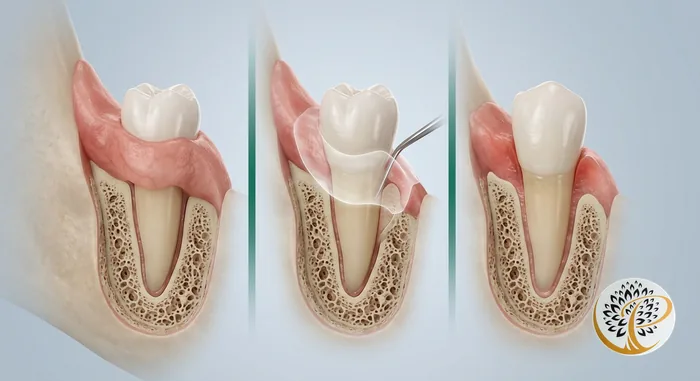
A typical crown lengthening procedure runs 30 to 90 minutes depending on the number of teeth involved, is performed under local anesthesia with optional sedation, and involves three steps: gum reshaping, bone reshaping, and suturing. Most patients leave the office with sutures in place and a clear set of post-operative instructions.
Local anesthesia is delivered first. If sedation has been chosen, that protocol begins now. Our sedation dentistry guide covers the available options and how they are matched to anxiety and medical history.
Once the area is fully numb, the periodontist makes precise incisions along the gum line and reflects a small flap of gum tissue to expose the underlying bone. A predetermined amount of bone is gently removed using fine instruments, with the goal of re-establishing the 2-to-3-millimeter biological width below the future restoration margin. The gum tissue is then trimmed if needed and sutured back into its new position.
The amount of tooth structure exposed depends on the indication. Functional cases typically expose 1 to 3 millimeters of additional tooth structure to allow restorative access. Esthetic cases vary based on the smile line and tooth proportions, often exposing 2 to 4 millimeters. Sutures are usually removed at the one-to-two-week follow-up. The site is then allowed to heal for an additional 6 to 8 weeks before the final restoration is placed by the general or restorative dentist.
What Does Recovery Look Like Week by Week?
Crown lengthening recovery is generally mild: tenderness and minor swelling for the first week, soft-food diet for 5 to 7 days, suture removal at 7 to 14 days, and full tissue maturation over 6 to 8 weeks before the final restoration is placed. Most patients return to work the next day.
The first 24 to 48 hours involve the most discomfort. Cold compresses on the outside of the face during the first day reduce swelling. Pain is typically managed with over-the-counter ibuprofen or acetaminophen, with prescription pain medication reserved for the first day or two if needed. Mild bleeding and oozing are normal during the first 12 hours.
Days 3 through 7 are the soft-food and gentle-care window. Lukewarm soups, eggs, smoothies, mashed potatoes, and yogurt work well. Avoid crunchy foods, anything that requires aggressive chewing on the surgical side, and very hot or very cold liquids. A prescribed antimicrobial rinse replaces brushing at the surgical site for the first one to two weeks, and gentle brushing of nearby teeth resumes once the periodontist confirms the area has stabilized.
The 6-to-8 week tissue maturation phase is invisible from the outside but critical for the final outcome. Gum tissue continues to mature, the gum margin stabilizes at its final position, and the underlying bone heals fully. Restorations placed too early can end up with margins that no longer match the gum line as it continues to settle. Dr. Parachuru coordinates with the restorative dentist to schedule the final restoration once the tissue has fully matured.
How Much Does Crown Lengthening Cost?
Crown lengthening costs in the Prosper, TX area typically range from $1,000 to $3,000 per tooth for functional cases and $1,500 to $4,000 or more for esthetic cases involving multiple teeth across the smile zone. Costs vary with case complexity, the number of teeth involved, sedation choices, and whether bone reshaping is needed.
Functional crown lengthening is often partially covered by dental insurance because it is medically necessary to allow a covered restoration to be placed. Pre-authorization typically helps clarify what the insurance carrier will pay before the procedure. Esthetic crown lengthening is generally considered cosmetic and is not covered by insurance, so the patient is responsible for the full fee.
Our team handles insurance verification and pre-authorization on every case and provides a written treatment plan with itemized costs before any surgical commitment. Cherry Financing is available for patients who want to spread the cost over time. The total cost picture also depends on whether the case is part of a larger treatment plan that includes restorative work, implant placement, or other periodontal therapy.
Why Does the Specialist Matter for This Procedure?
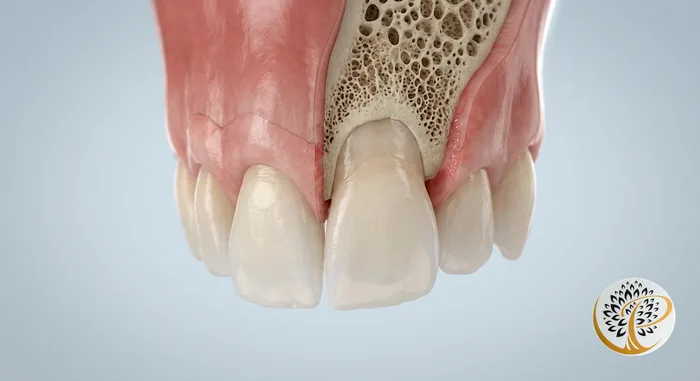
Crown lengthening looks straightforward on paper but requires careful planning and execution to avoid the two common failure modes: removing too much bone and compromising the tooth’s stability, or removing too little bone and watching the gum grow back over the exposed structure. A periodontist’s training is what produces the consistent outcome.
Periodontists complete a three-year specialty residency after dental school that focuses on the surgical management of bone and gum tissue. The judgment about how much bone to remove, where the new gum margin should sit, how to handle anatomic variations like high frenum attachments, and when to combine the procedure with adjacent gum grafting all reflect specialist training.
Dr. Parachuru completed his periodontics certificate at the University of Minnesota with a PhD in Immunology. The immunology background informs how he thinks about wound healing, inflammation, and the soft-tissue response that determines whether the gum margin stabilizes where it was placed. Crown lengthening cases are planned with measurements at the consultation, photographs of the smile line for esthetic cases, and coordination with the patient’s restorative dentist to confirm the planned outcome will support the planned restoration.
The patient takeaway is to confirm that crown lengthening is being performed by a periodontist rather than a general dentist, particularly in esthetic cases where the visible outcome is irreversible. Our meet our doctor page covers Dr. Parachuru’s training and approach.
Ready to Move Your Restoration Forward?
If your general dentist has flagged a tooth that needs crown lengthening before a crown or filling, or if you have been considering esthetic crown lengthening for a gummy smile, the next step is a periodontal consultation to confirm the indication, plan the procedure, and coordinate with your restorative dentist. Dr. Parachuru completed his periodontics certificate at the University of Minnesota with a PhD in Immunology, which means crown lengthening candidates at Prosper Periodontics are evaluated by a specialist who plans cases based on biology and esthetic principles, not approximations. We see patients from Prosper, Frisco, McKinney, Celina, and Aubrey at our office at 2300 E Prosper Trail Suite #20.
To schedule, call (972) 787-1122 or request a consultation online. Learn more about our procedural offerings on the specialized procedures service page, explore periodontal care, and review our first visit guide for what to expect at the consultation. Celina-area patients can read the periodontal care in Celina page.