
What Are Dental Implants? The Complete Patient Guide

Dental implants are titanium posts surgically placed into the jawbone to replace missing tooth roots, supporting crowns, bridges, or full-arch restorations with a documented success rate of 95 to 98 percent over 10 years. For patients in Prosper, TX and surrounding communities, implants represent the only tooth-replacement option that preserves jawbone and looks, feels, and functions like a natural tooth. This guide covers everything you need to know before your first consultation.
What Exactly Is a Dental Implant?
A dental implant is a three-part system: a titanium fixture, an abutment, and a crown. The fixture is a small screw-shaped post, typically 3.5 to 5 millimeters in diameter, that is placed into the jawbone where the tooth root once sat. Over a period of 3 to 6 months, the bone fuses directly to the titanium surface in a process called osseointegration. Once fused, the abutment connects the fixture to the final restoration, whether that is a single crown, a bridge, or a full-arch prosthesis.
The material matters. Medical-grade titanium (Grade IV or Grade V alloy) is used because it is biocompatible, meaning the body does not reject it. Some patients choose zirconia implants for metal-free preferences, and these have shown comparable short-term success rates, though titanium remains the gold standard backed by decades of clinical data.
The crown or restoration on top is typically made from porcelain, zirconia, or a porcelain-fused-to-metal composite. These materials are matched to your natural tooth shade so the final result is indistinguishable from the teeth around it.
Clinical Evidence
Titanium implants demonstrate osseointegration success rates of 95 to 98 percent over 10 years in patients with adequate bone volume and controlled systemic health. — Journal of Dental Research (Albrektsson T, Donos N, 2012)
What Are the Different Types of Dental Implants?
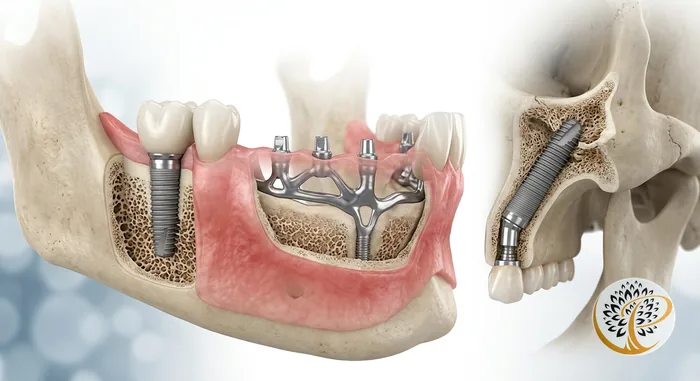
There are four main implant configurations, each suited to a different clinical situation. Choosing the right type depends on how many teeth you are missing, the quality of your bone, and your overall treatment goals.
Single-Tooth Implant
A single implant replaces one missing tooth without affecting the adjacent teeth. This is the most common configuration and is the preferred option when the surrounding teeth are healthy. The implant stands independently, meaning no neighboring tooth is ground down to support a bridge.
Implant-Supported Bridge
When two or more adjacent teeth are missing, two implants can anchor a bridge that spans the gap. This avoids placing an implant under every missing tooth while still providing fixed, non-removable restoration. It is a cost-effective middle ground between single implants and full-arch solutions.
Implant-Retained Denture
For patients who already wear or need a full denture, 2 to 4 implants can anchor the denture so it snaps in and out securely rather than floating on gum tissue. This dramatically improves chewing force and eliminates the need for denture adhesives.
Full-Arch Fixed Bridge (All-on-4 / All-on-X)
The most comprehensive option replaces an entire upper or lower arch using just 4 to 6 implants. The angled placement of the posterior implants allows the prosthesis to be fixed permanently in place the same day in many cases. Learn more at our All-on-4 service page and read our detailed comparison in All-on-4 vs Dentures.
Who Is a Good Candidate for Dental Implants?
Most healthy adults who are missing one or more teeth are potential candidates, but three factors determine success more than any other: bone volume, gum health, and systemic health.
Bone Volume
The implant needs enough bone to anchor into. A minimum of 10 millimeters of vertical bone height and 6 millimeters of width is typically required. Cone beam CT (CBCT) imaging gives a precise three-dimensional measurement before treatment begins. Patients who have experienced bone resorption due to long-term tooth loss can often still receive implants after bone grafting. Read more in our guide on dental implant costs in Prosper, TX.
Gum Health
Active periodontal disease is one of the most common reasons implant candidates are turned away – or should be. Placing an implant into a mouth with untreated gum disease significantly increases the risk of peri-implantitis, an infection of the tissue around the implant. At Prosper Periodontics, every implant patient receives a thorough periodontal evaluation first. Visit our Periodontal Care page for more on how we address this before implant placement.
Systemic Health Factors
Uncontrolled diabetes slows healing and increases infection risk. Patients on bisphosphonate medications (used for osteoporosis) face a rare but serious risk called osteonecrosis of the jaw. Heavy smokers have a 2 to 3 times higher implant failure rate compared to non-smokers. These are not automatic disqualifiers – they require careful evaluation and often management before proceeding.
Expert Insight
“I evaluate every implant patient through a periodontal lens first. An implant placed in a mouth with active infection will fail. The foundation has to be solid before we build on it.”
— Dr. Parachuru, Periodontist
What Does the Dental Implant Process Look Like Step by Step?
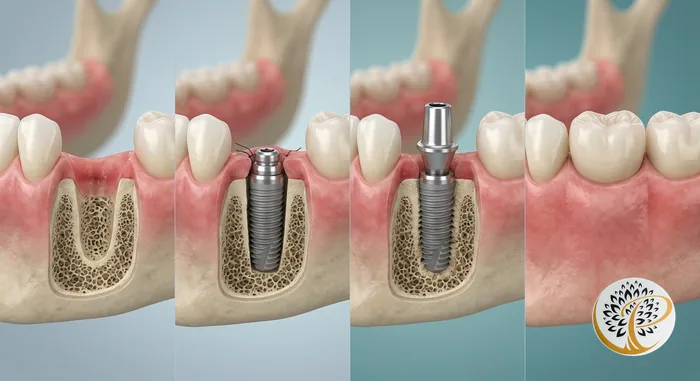
The implant process typically unfolds across 4 to 5 appointments over 3 to 6 months, depending on whether extractions, bone grafting, or staged healing are required.
Step 1: Consultation and CBCT Imaging
Your first appointment includes a full clinical examination, digital X-rays, and a cone beam CT scan. The CBCT gives a 3D image of your bone density and volume, sinus position, nerve locations, and any anatomical considerations. This data drives the surgical plan and determines whether preparatory bone grafting is needed.
Step 2: Preparatory Procedures (If Needed)
If a tooth still needs removal, extraction happens first and the socket is typically grafted at the same time to preserve bone volume. If existing bone is insufficient, a separate bone graft procedure is performed with a healing period of 4 to 6 months. Patients with significant bone resorption after years of wearing a denture most commonly need this step.
Step 3: Implant Placement Surgery
The placement procedure is performed under local anesthesia, with sedation available for anxious patients (see our Sedation Dentistry page). A small incision is made in the gum, the bone is prepared with sequential drills, and the titanium fixture is threaded precisely into position. The gum is sutured closed and a healing cap is placed. Most patients describe the procedure as more comfortable than a tooth extraction.
Step 4: Osseointegration (3 to 6 Months)
This is the biological phase. The jawbone grows into the micro-textured surface of the titanium implant until the fixture is mechanically locked in place. The timeline depends on bone density, location in the mouth (lower jaw heals faster), and your general health. A follow-up appointment confirms integration before the next step.
Step 5: Abutment Placement and Restoration
Once the implant has integrated, the abutment is attached and impressions are taken for your custom crown. The final crown is then placed and adjusted for ideal bite. Some systems allow the abutment and crown to be placed at the same appointment as the implant (immediate loading), which your provider will assess based on your bone density and implant stability readings.
Read our detailed guide at Dental Implant Recovery Guide for post-surgical care instructions and timelines.
What Are the Success Rates and Risks of Dental Implants?
Clinical literature consistently reports 10-year survival rates of 95 to 98 percent for single implants placed in healthy patients, making implants one of the most predictable procedures in all of dentistry.
However, risks exist and patients deserve to understand them clearly. The most common complications include:
- Peri-implantitis: An infection of the tissue around the implant, similar to gum disease. It affects an estimated 10 to 20 percent of implants over the long term if hygiene lapses.
- Early failure: Rare (under 3 percent) and typically caused by infection, smoking, or inadequate bone contact at the time of placement.
- Mechanical complications: Screw loosening or crown fracture, more common with full-arch prosthetics, usually repairable without implant removal.
- Nerve sensitivity: Temporary tingling or numbness in the lower jaw, usually resolving within weeks. Permanent nerve injury is rare when cone beam CT imaging guides surgical planning.
Clinical Evidence
Peri-implantitis affects approximately 10 to 22 percent of implant sites at 10 years, making periodontal maintenance protocols critical to long-term implant survival. — Clinical Oral Implants Research (Derks J, Tomasi C, 2015)
How Do Dental Implants Compare to Bridges and Dentures?
The fundamental difference between implants and every other tooth-replacement option is bone preservation. When a tooth is lost, the jawbone underneath begins to resorb because there is no longer a root stimulating it. A bridge or denture replaces the visible tooth but does nothing to stop this bone loss. Over 10 to 20 years, significant bone resorption changes facial structure, makes future implants harder, and weakens surrounding teeth.
Bridges require grinding down healthy adjacent teeth to create anchor points. Once those teeth are crowned, they are more vulnerable to decay and nerve damage for the rest of that patient’s life. Implants stand independently and leave neighboring teeth completely untouched.
For a full side-by-side breakdown of costs, longevity, and clinical tradeoffs, see our post Single Tooth Implant vs Bridge: Which Is Better?
Why Should You Choose a Periodontist for Dental Implants Over a General Dentist?
Periodontists complete 3 additional years of surgical specialty training after dental school, focused specifically on the bone, gum tissue, and biological structures that determine whether an implant succeeds or fails.
Dr. Parachuru holds a PhD in the Immunology of Periodontal Diseases and a Certificate in Periodontics from the University of Minnesota – credentials that no general dentist can replicate. His research background means he understands the biological mechanisms of osseointegration, infection risk, and tissue healing at a level that directly informs surgical decisions. When a case is complex – thin bone, prior infection, systemic health factors – this depth of training makes a measurable difference in outcomes.
General dentists increasingly place implants, and many do so competently for straightforward cases. But for patients with any complicating factor, a periodontist’s specialized skill set provides a clear clinical advantage. View our full Dental Implants service page to see Dr. Parachuru’s approach and patient experience.
Expert Insight
“My PhD research in periodontal immunology directly applies to implant placement. Understanding how the body responds to infection and foreign materials helps me anticipate complications before they happen and build treatment plans that hold up for decades.”
— Dr. Parachuru, Periodontist
Frequently Asked Questions
How much do dental implants cost in Prosper, TX?
A single implant including the fixture, abutment, and crown typically ranges from $3,000 to $5,500 in the Prosper, TX area. Full-arch All-on-4 restorations range from $20,000 to $35,000 per arch. Many dental insurance plans now provide partial coverage for the crown portion, and financing options through CareCredit and similar programs are available. See our full cost breakdown at Dental Implant Cost in Prosper, TX.
Does the implant procedure hurt?
Most patients report less discomfort than they expected. The procedure is performed under local anesthesia, which fully numbs the surgical site. Sedation is available for patients with dental anxiety. Post-operative discomfort typically peaks on days 2 and 3 and is managed with over-the-counter anti-inflammatories in most cases. See our recovery guide for a complete timeline.
How long does it take to get a dental implant from start to finish?
The total treatment timeline is typically 3 to 6 months for a straightforward single implant. Cases requiring bone grafting can extend to 9 to 12 months. Immediate-load protocols, where the crown is placed the same day as the implant in select patients, can compress this significantly. Your CBCT scan results will clarify which timeline applies to your case.
Can I get a dental implant if I have gum disease?
Active gum disease must be treated and controlled before implant placement. Placing an implant into an infected site dramatically increases failure risk. The good news is that gum disease is treatable. At Prosper Periodontics, we address the periodontal condition first, confirm stability, and then proceed with implant planning. Read more about treatment options at our Periodontal Care page.
What happens if a dental implant fails?
Implant failure is rare (under 5 percent) but does occur. Early failure (within the first few months) is typically due to infection or poor osseointegration. Late failure is most often caused by peri-implantitis. In most cases, the failed implant is removed, the site is allowed to heal, and re-implantation is performed successfully. The fact that an implant failed once does not mean you cannot have another placed.
Are dental implants safe for older patients?
Age alone is not a contraindication. Studies have shown implant success rates in patients over 70 are comparable to younger patients when systemic health is well-managed. The more relevant factors are bone density, gum health, and medication list. Many older patients are excellent candidates and benefit greatly from the improved chewing function and nutritional outcomes implants provide.
How do I care for a dental implant?
Daily brushing and flossing apply to implants just as they do to natural teeth. Because implants are susceptible to peri-implantitis if plaque accumulates, meticulous hygiene is non-negotiable. Interdental brushes and water flossers are particularly effective around implant crowns. Professional cleanings every 3 to 6 months, depending on your periodontal history, are essential for long-term success.
Schedule Your Consultation
If you are missing a tooth or considering implants, the first step is a comprehensive consultation with a periodontist who can evaluate your bone, gum health, and overall candidacy. Dr. Parachuru and the team at Prosper Periodontics and Dental Implants are ready to answer your questions, review your imaging, and build a treatment plan tailored to your situation. Call us at (972) 787-1122 or book your consultation online.
Related Resources
- Dental Implants – Service Overview
- All-on-4 Full Arch Implants
- Periodontal Care at Prosper Periodontics
- Sedation Dentistry for Implant Procedures
- Dental Implant Cost in Prosper, TX
- Dental Implant Recovery Guide
- All-on-4 vs Dentures: Full Comparison
- Signs of Gum Disease
Serving Prosper, TX and Surrounding Communities
Prosper Periodontics and Dental Implants serves patients throughout Collin County and beyond. If you are searching for dental implants near you, we welcome patients from Frisco, Celina, and McKinney. Our practice is located at 2300 E Prosper Trail Suite #20, Prosper, TX 75078, with convenient access from US-380 and the Preston Road corridor.