
All-on-4 vs All-on-6: Which Full Arch Solution Is Right for You?

When a periodontist or implant surgeon presents you with full-arch options, the conversation often narrows to two protocols: All-on-4 and All-on-6. Both restore an entire arch of teeth using a fixed prosthesis screwed into titanium implants. The difference is the number of anchor points and how that number affects cost, surgical complexity, candidacy, and long-term performance. This guide breaks down where each option fits, where the differences actually matter, and how Dr. Praveen Parachuru thinks about the decision at Prosper Periodontics.
What Is the Difference Between All-on-4 and All-on-6?
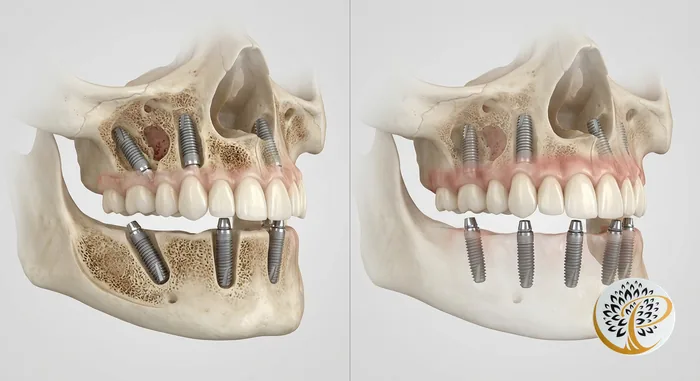
The simplest way to describe the difference: All-on-4 supports a full arch on four implants, while All-on-6 uses six. Both protocols anchor a one-piece prosthesis directly to the implants. Both eliminate the slipping and adhesive of conventional dentures. Both preserve jawbone by transmitting biting forces into the bone the same way natural roots do. The difference lies in how those forces are distributed and how much bone you need to support the design.
All-on-4 places two implants vertically in the front of the arch and two posterior implants tilted at 30 to 45 degrees. The tilted implants engage denser bone in the front and middle of the jaw and bypass anatomical structures (the maxillary sinus on top, the inferior alveolar nerve on the bottom) that often have limited bone above them. This design is what allows All-on-4 to succeed in patients with significant posterior bone loss without requiring sinus lifts or grafting.
All-on-6 adds two more implants, typically positioned between the front and back implant sites. Some surgeons place all six vertically, while others use the same tilted-posterior approach as All-on-4 with additional vertical implants in between. The extra two implants spread biting force across more anchor points and provide redundancy. If one implant were ever to fail, the prosthesis still has five well-distributed supports.
Neither protocol is universally superior. The right answer depends on your bone, your bite, and your goals.
When Is All-on-4 the Better Choice?
All-on-4 is the better choice for the majority of full-arch patients, particularly those with moderate to significant posterior bone loss who want to avoid grafting. That covers a large share of the patient population because most people who reach the point of considering full-arch replacement have spent years with missing or failing teeth, and posterior bone loss has already occurred.
The angled posterior implants in All-on-4 are engineered specifically to engage available bone in front of the sinus and forward of the inferior alveolar nerve. In patients with thin posterior bone, this design eliminates the need for sinus lifts (which add three to nine months and several thousand dollars to treatment) or extensive grafting. Studies on the original Malo Clinic protocol document survival rates of 94 to 98 percent at 10 years, which is comparable to outcomes reported for vertically placed implants in patients with adequate bone.
All-on-4 also makes sense when budget is a primary consideration. Two fewer implants means two fewer surgical sites, less surgical time, and lower component cost. The savings typically run several thousand dollars per arch compared to All-on-6, which can be the difference between proceeding with treatment now versus deferring it for another year of bone loss.
For patients who have been told they “do not have enough bone for implants” by a previous provider, All-on-4 is often the option that re-opens the door. Dr. Parachuru reviews 3D CBCT imaging at the consultation visit and can determine within minutes whether the angled-posterior approach is viable for your anatomy.
When Is All-on-6 the Better Choice?
All-on-6 makes more clinical sense when bone volume is adequate, bite force is unusually heavy, or the patient has specific risk factors that benefit from extra anchor points. The decision is less common than All-on-4 in our patient population, but it has clear use cases.
Heavy bruxers (patients who grind or clench) generate biting forces that can exceed 250 pounds per square inch at the molars. Distributing those forces across six implants instead of four reduces the load on each implant and the prosthesis. For patients with documented bruxism or unusually muscular jaw anatomy, the additional implants can extend the lifespan of the prosthesis by years and reduce the rate of mechanical complications like screw loosening or porcelain chipping.
Patients with adequate bone volume across the full arch (including good posterior bone) may benefit from vertical implant placement at six sites instead of four with two tilted. Vertical implants engage bone along their full length and can be slightly more straightforward to maintain over time. When the anatomy supports it, six vertical implants distribute force more evenly than four tilted implants, though the practical difference for most patients is small.
All-on-6 also offers redundancy. If one implant were to fail in an All-on-4 case, all four supports are needed and the prosthesis must be temporarily managed while the failed implant is replaced. With All-on-6, the prosthesis can often continue functioning on the remaining five implants while the failed site heals. This is a meaningful consideration for patients who are particularly risk-averse or whose work and lifestyle would be significantly disrupted by any treatment interruption.
Patients with full-arch maxillary cases (upper jaw) sometimes benefit from All-on-6 because the upper jaw has lower bone density than the lower jaw and the maxillary prosthesis spans a larger curve. The extra implants compensate for both factors.
How Do Cost and Recovery Compare?
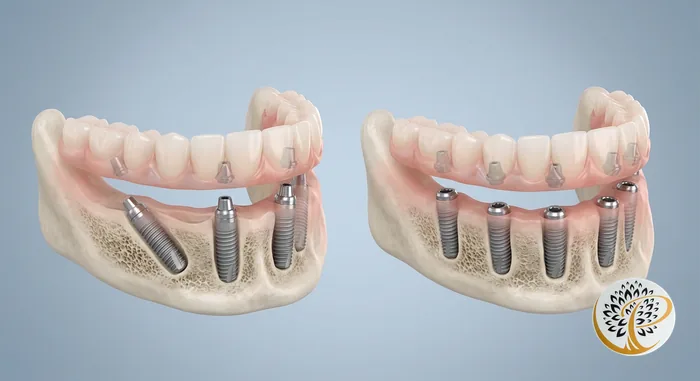
All-on-6 typically costs $4,000 to $8,000 more per arch than All-on-4, with longer surgical time and a recovery profile that is similar but slightly more involved. The cost difference reflects two additional implants, two additional surgical sites, additional component costs (abutments and screws), and longer chair time on surgery day.
In the Prosper area, All-on-4 commonly runs $20,000 to $30,000 per arch, while All-on-6 commonly runs $25,000 to $35,000 per arch. Final pricing depends on materials (titanium versus zirconia, milled versus pressed prosthesis), sedation level, and any preparatory procedures. Both protocols qualify for Cherry Financing, which spreads payments over terms that fit a range of household budgets.
Surgical time runs roughly four to six hours for All-on-4 and five to seven hours for All-on-6. Both procedures use IV sedation, and most patients describe minimal awareness of the experience. Recovery follows a similar timeline. Swelling peaks at days two to three, soft foods are appropriate for six to eight weeks, and full function returns once the final prosthesis is placed at three to four months. The two extra surgical sites in All-on-6 add modestly to swelling and soreness in the first week, but patients consistently describe the difference as minor.
Long-term maintenance costs are essentially equivalent between the two protocols. Both require professional maintenance visits every six months, daily home care with implant-specific tools, and periodic prosthesis maintenance over the years. For an honest look at total ownership cost, our dental implant cost guide for Prosper, TX covers the full pricing picture in detail.
Are Long-Term Outcomes Different Between All-on-4 and All-on-6?
Long-term implant survival rates are statistically similar between All-on-4 and All-on-6, with the strongest predictor of success being case selection and surgical technique rather than implant count. That is the consensus across two decades of peer-reviewed literature.
The All-on-4 protocol has been studied since the late 1990s, with multiple 10-year and 15-year studies documenting implant survival in the 94 to 98 percent range. Prosthetic survival (the prosthesis itself remaining functional without major complication) is in a similar range, though with predictable maintenance events like screw retightening or occasional repair of chipping. All-on-6 has shorter long-term data because the protocol was developed later, but the available studies show comparable survival in patients with appropriate candidacy.
Where the two protocols may diverge is in failure tolerance. Studies suggest that an All-on-4 case can lose one implant and still function, but the remaining three implants are heavily loaded and the prosthesis often needs revision. An All-on-6 case can lose one implant and continue functioning on the remaining five with little to no clinical compromise. This is a meaningful but rare scenario. Implant failure rates are low overall, and patients should not over-weight the failure-tolerance factor unless other clinical factors also favor All-on-6.
Bone preservation is similar between the two protocols. Both transmit biting forces into the bone through osseointegration, both prevent the progressive jawbone resorption seen in conventional denture wearers, and both maintain facial structure and bite stability over decades. For more on long-term implant performance generally, our how long do dental implants last guide covers the data across implant types.
How Does Dr. Parachuru Decide Which Protocol Is Right for You?
The decision is anchored in three inputs: 3D imaging, an in-person clinical exam, and a candid conversation about your goals, budget, and risk tolerance. No two patients receive the same recommendation because no two patients have the same bone, bite, or life situation.
The 3D CBCT scan tells the clinical story first. Available bone volume, bone density, sinus position, nerve location, and the spatial relationship between the upper and lower arches all show up on the scan. In some cases, the imaging makes the answer obvious. A patient with adequate bone across the full arch and a heavy bite is a clear All-on-6 candidate. A patient with significant posterior bone loss and a normal bite is a clear All-on-4 candidate. In most cases, however, the imaging supports either option, and the decision becomes a values question.
The clinical exam adds context the imaging cannot provide. Bite alignment, soft-tissue health, gum biotype, and signs of bruxism or clenching all factor into the recommendation. Patients with worn dentition or fractured teeth from grinding receive a stronger recommendation toward All-on-6 if their anatomy supports it. Patients with normal bite mechanics typically do well with All-on-4.
The conversation is where Dr. Parachuru lays out the trade-offs and listens to what matters to the patient. Some patients prioritize lower upfront cost. Some prioritize maximum redundancy. Some prioritize the shortest path to a fixed full arch with no detours into grafting. The protocol that best matches the patient’s priorities, given their anatomy, is the right answer for them.
That is the consultation experience at Prosper Periodontics. You leave with a recommendation, the reasoning behind it, and a transparent cost and timeline. For patients still deciding whether full-arch implants are the right approach at all, our All-on-4 vs dentures comparison is the more foundational starting point.
Ready to Restore Your Smile?
Choosing between All-on-4 and All-on-6 is not a decision you should make from a website. The right protocol depends on your specific bone, bite, and goals, and the only way to know with confidence is a 3D scan and an in-person evaluation. Dr. Parachuru combines a periodontics certificate from the University of Minnesota with a PhD in Immunology, which gives him a working understanding of both the surgical mechanics and the bone and tissue biology that drives long-term success. We see patients from Prosper, Frisco, McKinney, Celina, and Aubrey at our office at 2300 E Prosper Trail Suite #20.
To schedule a consultation, call (972) 787-1122 or request an appointment online. Learn more about our protocol and what patients experience on the All-on-4 service page. Whether the right answer for you is four implants or six, the conversation starts the same way: a clear scan, an honest exam, and a treatment plan you can trust.