
Pinhole Surgical Technique vs Gum Grafting: How to Choose

When patients research treatment for receding gums, two approaches dominate the conversation. The Pinhole Surgical Technique (PST), developed and trademarked by Dr. John Chao, has been marketed aggressively as a minimally invasive alternative to traditional grafting. Connective tissue grafting (the gold standard surgical approach) has decades of published outcomes data behind it. Both have legitimate indications, and the right choice depends on the specifics of your recession pattern, the thickness of your existing gum tissue, the number of teeth involved, and your priorities for recovery time and long-term durability. This guide walks through the meaningful differences so you can have an informed conversation with a periodontist. Dr. Praveen Parachuru evaluates recession cases at Prosper Periodontics and selects the technique that fits the patient rather than the technique the practice prefers to perform.
What Is the Pinhole Surgical Technique and How Does It Work?
The Pinhole Surgical Technique repositions existing gum tissue over exposed roots through a small access point in the tissue, with no scalpel incisions, no sutures, and no removal of donor tissue from another part of the mouth.
The procedure begins with local anesthesia at the treatment area. A small entry point (the pinhole) is made in the gum tissue above the receded teeth using a specialized instrument. Through that entry point, a series of slim instruments are used to gently release the gum tissue from its bony attachment and slide it coronally (toward the crown of the tooth) to cover the exposed root surface. Collagen membrane strips are sometimes inserted through the same entry point to stabilize the tissue in its new position during initial healing.
The technique can address multiple adjacent teeth in a single visit, sometimes an entire arch of recession defects in ninety minutes to two hours. The lack of incisions and sutures is the headline feature for most patients. There is no surgical site that needs to be sutured closed, and the small entry point heals over within a few days.
PST is performed only by clinicians who have completed specific Chao Pinhole certification training. The technique requires a defined skill set in tissue manipulation that is different from traditional grafting, so not every periodontist offers it. The certification is a meaningful credential to look for if pinhole is the technique you are considering.
What Is Connective Tissue Grafting and How Does It Work?
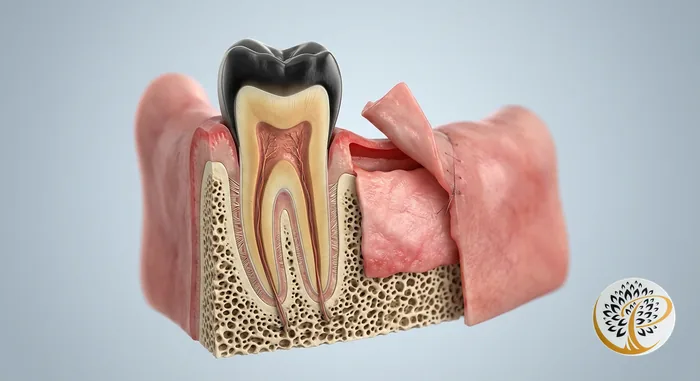
Connective tissue grafting is the gold standard surgical technique for treating gum recession, in which a small amount of tissue is harvested from the patient’s palate (or from donor material) and placed under a partial-thickness flap at the recession site, with sutures closing both the donor and recipient sites.
The procedure begins with local anesthesia at both the recipient site (the area of recession) and the donor site (the palate, in autogenous CTG cases). A partial-thickness flap is gently elevated at the recipient site over the receded teeth, exposing the root surfaces and creating a bed for the graft. The donor tissue is harvested as a small section of subepithelial connective tissue from beneath a flap on the palate. The harvested tissue is trimmed to fit the recipient bed, placed precisely over the exposed roots, and sutured into position. The covering flap at the recipient site is then repositioned over the graft, sandwiching it between the patient’s own surface tissue and the underlying bed.
Acellular dermal matrix (commonly known by the brand name Alloderm) replaces the autogenous donor tissue with processed donor tissue, which avoids the palatal donor site entirely. This option is well-supported in the literature for many indications and is a particularly common choice when multiple teeth across both quadrants need treatment in a single visit.
The published track record for CTG is substantial. Systematic reviews show 85 to 95 percent root coverage at one year in well-selected cases, with the majority of patients achieving complete or near-complete coverage. The graft also produces a meaningful gain in tissue thickness, which is independently protective against future recession.
How Do the Recovery Experiences Compare?
Pinhole recovery is faster and involves fewer dietary restrictions, with most patients returning to normal activities within two to three days, while connective tissue grafting recovery extends over a full first week with a soft-food diet and longer healing of the palatal donor site.
For pinhole, the first forty-eight hours involve mild swelling and tenderness at the entry point and treated area. Most patients use over-the-counter ibuprofen and resume normal eating after the first day, avoiding direct contact with the treated area. There is no donor site to manage. By day three or four most patients are essentially back to normal aside from continued caution around the treated teeth for the first one to two weeks. Sutures are not present so there is no suture removal visit.
For connective tissue grafting, the first three days involve more noticeable awareness of both the recipient site (where the graft is healing) and the donor site (where palatal tissue was harvested). The palate site is often the most prominent source of discomfort during the first week because eating creates contact with the healing area. Most patients use over-the-counter pain medication. A soft-food diet is followed for at least seven days. Sutures are typically removed at the two-week post-operative visit unless absorbable sutures were used. The graft itself is firmly attached at two weeks but the surface tissue continues to mature over the following two to three months.
The recovery difference is real, and for some patients it is the deciding factor. For other patients the outcome durability and tissue thickness gain matters more than the first-week experience.
Who Is the Better Candidate for Pinhole?
Pinhole is the better choice for patients with multi-tooth moderate recession, adequate existing tissue thickness, no underlying periodontitis, and a strong preference for shorter recovery and avoidance of a palatal donor site.
The strongest pinhole candidates have generalized recession across several adjacent teeth where the existing tissue is sufficiently thick to be repositioned coronally. Patients who want to address an entire smile zone in a single visit benefit from the multi-tooth efficiency of the technique. Patients with anxiety about palatal donor sites or about traditional surgical recovery often find pinhole approachable in a way that grafting was not.
Pinhole is appropriate for patients with stable periodontal status (no active periodontitis at the treatment area). Patients with active periodontitis need that disease controlled before any cosmetic correction, and pinhole does not address bacterial infection or pocket depth.
Pinhole is also a reasonable choice for patients who have already had successful grafting in some areas and need additional coverage in adjacent quadrants without committing to another full graft procedure with another donor site.
Who Is the Better Candidate for Connective Tissue Grafting?
Connective tissue grafting is the better choice for patients with thin gum tissue who need a tissue thickness gain, severe recession defects, single-tooth focal recession on key esthetic teeth, and patients who prioritize the most thoroughly studied long-term outcomes regardless of recovery time.
The single strongest indication for grafting over pinhole is thin biotype. Pinhole repositions existing tissue. It does not add tissue. Patients whose gum tissue is naturally thin and translucent benefit substantially from the volume gain that a connective tissue graft delivers, both for immediate root coverage and for protection against future recession. The added thickness changes the tissue’s resilience to mechanical and inflammatory insult.
Severe recession with extensive root exposure also tends to favor grafting. The amount of coronal repositioning needed in severe defects sometimes exceeds what pinhole can predictably achieve, and the thicker tissue placement of a graft is more reliable. Single-tooth recession on a key esthetic tooth (for example, an upper front tooth where exact color match and complete coverage are paramount) is another strong indication for CTG because the technique allows precise placement and predictable cosmetic blending.
Patients who place high value on the published evidence base may choose grafting because the literature is older and deeper. Pinhole has good outcome data, but the volume of randomized controlled trials and long-term follow-up studies is smaller than for CTG simply because the technique is newer.
How Do Cost and Insurance Coverage Compare?
Pinhole and connective tissue grafting are typically priced in a similar range per treated tooth, with multi-tooth pinhole sometimes costing less per tooth due to the efficiency of the single-visit approach, and insurance coverage is variable for both because gum recession is sometimes considered cosmetic.
Single-tooth grafting fees vary by region and case complexity. Multi-tooth cases scale roughly proportionally for grafting, while pinhole often offers a meaningful per-tooth discount because much of the procedural time is the access and preparation rather than per-tooth work. The exact figures for any given case depend on the number of teeth, the technique selected, the use of donor matrix or membrane materials, and whether sedation is involved.
Dental insurance treatment of gum recession is inconsistent across plans. Some plans cover grafting when there is documented periodontal need (deep pockets, attached tissue loss, or active periodontitis component). Other plans treat recession correction as cosmetic and provide no coverage. Pinhole is sometimes covered as a graft procedure under existing graft codes and sometimes excluded depending on plan language. Our office verifies benefits before treatment and provides written estimates so patients know exactly what their out-of-pocket cost will be. For patients who want to spread the investment over time, Cherry financing offers transparent payment plans.
What About Long-Term Durability and Outcomes?
Both techniques have favorable long-term outcomes when performed for the right indications, with grafting having a longer published track record (decades of follow-up studies) and pinhole showing strong outcomes in the published literature available so far (about a decade of formal follow-up).
For grafting, ten-year success rates exceed 90 percent in most published studies, and twenty-year follow-up data exists for connective tissue grafts performed in the late twentieth century. The tissue thickness gain produced by grafting persists over decades when patients maintain good periodontal health.
For pinhole, the longest published follow-up cohorts now extend to roughly ten years and show favorable outcomes in well-selected cases. The technique has been refined since its introduction, so very long-term data on current technique is still accumulating. Patients who undergo pinhole and maintain regular periodontal care typically retain their results well, and the recurrence patterns reported in the literature are consistent with what is seen after grafting in similar patient profiles.
The variable that affects long-term durability for both techniques more than the technique itself is what caused the original recession. If aggressive brushing is the cause and is not corrected, recession recurs. If the cause was active periodontitis and the disease is not maintained, recession recurs. If the cause was orthodontic positioning and the underlying anatomy is unchanged, the area remains at risk. Choosing the right technique without addressing the cause produces a result that regresses regardless of which procedure was performed.
How Does a Periodontist Decide Which Technique Fits Your Case?
The decision flows from a comprehensive recession evaluation that maps the defects, measures tissue thickness, identifies the underlying cause, and matches those findings to the technique that gives you the most predictable result for your specific situation.
The exam begins with measurement of each recession defect in millimeters and characterization of biotype as thick or thin. The number of teeth involved, the distribution across the mouth, and the cosmetic priority of each affected tooth are documented. The cause of the recession is identified through history (brushing technique, orthodontic history, bruxism evaluation) and clinical signs (wear patterns, bite analysis). The presence or absence of active periodontal disease is determined.
The technique recommendation that emerges is matched to those findings rather than to a practice preference. A patient with thin biotype on key esthetic teeth typically gets a recommendation for connective tissue grafting because that produces the tissue thickness gain that protects against recurrence. A patient with thick biotype and multi-tooth moderate recession across an entire arch typically gets a recommendation for pinhole because the technique fits the case and offers the recovery advantage. Patients with mixed presentations sometimes get a phased plan that uses both techniques in different areas based on what each area needs.
The honest framing during this conversation matters. Both techniques have a place, and a periodontist who only offers one is more likely to recommend that one regardless of what the case calls for. Our first visit periodontist guide describes the evaluation in more detail, and the gum recession service page covers our overall approach to recession care.
Ready to Restore Your Gum Health?
If you have been considering pinhole or grafting and want a candid evaluation of which technique fits your specific case, the next step is a consultation that includes recession measurement, biotype assessment, photography, and a transparent comparison of the options. Dr. Praveen Parachuru completed his periodontics certificate at the University of Minnesota alongside a PhD in Immunology, which means recession cases at Prosper Periodontics are evaluated by a clinician trained in both surgical technique and the tissue biology that determines long-term outcomes. We see patients from Prosper, Frisco, McKinney, Celina, and Aubrey at our office at 2300 E Prosper Trail Suite #20.
To schedule a consultation, call (972) 787-1122 or request an appointment online. Learn more on the gum recession and grafting service page or, for nearby patients, the Frisco gum grafting page covers what to expect for that area specifically.