
Periodontist vs Dentist: When Do You Need a Specialist?
Most people see a general dentist twice a year for cleanings and routine care, and that visit covers the vast majority of what their mouth needs over a lifetime. But for a meaningful subset of conditions, the right provider is a periodontist: a dentist who has completed an additional three years of specialty training focused on the bone, gum tissue, and dental implant biology that drive long-term oral health. Knowing the difference matters because the wrong provider can mean treatment delay, escalating disease, and avoidable tooth loss. This guide walks through the training differences, what each provider treats, the red flags that warrant a specialist, and how to decide whether to wait for a referral or schedule directly. Dr. Praveen Parachuru holds both a periodontics certificate and a PhD in Immunology from the University of Minnesota, which is an unusual combination of credentials within periodontics itself.
What Is the Training Difference Between a Periodontist and a Dentist?
A general dentist completes 4 years of dental school after college, while a periodontist completes 4 years of dental school plus an additional 3 years of full-time specialty residency in periodontics. The total post-college training difference is roughly 3 years and 6,000 to 7,000 supervised clinical hours.
Dental school covers the full breadth of oral health: tooth restoration, prosthetics, endodontics (root canals), basic oral surgery, pediatrics, orthodontic basics, and an introduction to periodontics. The graduate is well prepared for general practice but has only limited hands-on training in the surgical management of advanced gum disease and dental implant placement.
Periodontics residency is a 3-year program accredited by the Commission on Dental Accreditation (CODA) and recognized by the American Dental Association as one of the dental specialties. The residency focuses entirely on diagnosing and treating gum disease, performing periodontal and bone-grafting surgery, placing dental implants, and managing the soft and hard tissue around teeth and implants. Residents handle hundreds of complex cases under specialist supervision before independent practice.
A small subset of periodontists also pursue research-focused PhD programs that add 3 to 5 years of additional training in the basic sciences underlying periodontal disease. Dr. Parachuru’s PhD in Immunology, completed at the University of Minnesota alongside his periodontics certificate, is in this category. The immunology background informs how he approaches chronic infection, host inflammatory response, and the bacterial-immune interaction that drives periodontitis at the tissue level. Our meet our doctor page covers the full training background.
What Does a General Dentist Typically Treat?
A general dentist handles the routine and intermediate-complexity care that the majority of patients need: cleanings, fillings, crowns, bridges, root canals, simple extractions, and the diagnosis of conditions that may need specialist referral. The general dentist is the foundation of most patients’ care.
A typical general dentistry practice covers preventive cleanings every 6 months, X-rays for diagnosis, fillings for cavities, crowns for damaged teeth, bridges for missing teeth, root canals for infected pulp, extractions of straightforward teeth, fitting of removable dentures, and basic cosmetic procedures like whitening and bonding. Many general dentists also offer some periodontal care (scaling and root planing for early gum disease) and have completed continuing education in implant placement or other specialty areas.
The general dentist’s most important role is screening. They are the front line for identifying conditions that need specialist evaluation. A general dentist who flags deep pockets at a routine cleaning, identifies bone loss on a routine X-ray, or notices early gum recession is doing the job correctly even when the result is a referral out of their practice. Studies suggest that early specialist evaluation produces better long-term outcomes than delayed referral for most periodontal conditions.
Some patients try to consolidate all their care with a single provider. That approach works for routine care, but for the procedures listed in the next section, the outcome differential between a generalist and a specialist is well-documented in the literature.
What Does a Periodontist Treat?

A periodontist focuses on conditions affecting the gums, bone, and supporting structures of the teeth, plus dental implant placement. The case mix in a typical periodontal practice runs heavily toward five areas: gum disease, dental implants, gum grafting, crown lengthening, and bone grafting.
Gum disease management is the foundational specialty. Periodontists diagnose and stage periodontitis using the AAP classification system, perform LANAP laser therapy for moderate cases, perform osseous (flap) surgery for severe cases, and provide the long-term maintenance protocol that holds the result in place. Our signs of gum disease guide covers what early disease looks like, and the can gum disease be reversed guide covers the boundary between reversible gingivitis and established periodontitis.
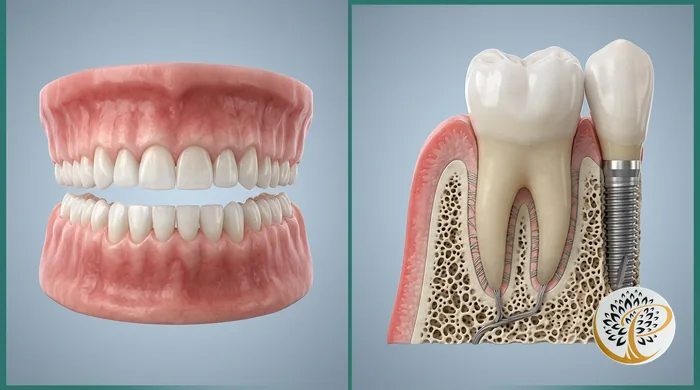
Dental implant placement is the second-largest case volume in most periodontal practices. Periodontists place single implants, multi-tooth implant cases, and full-arch All-on-4 implant cases. Comparative studies suggest implants placed by specialists (periodontists and oral surgeons) have survival rates 1 to 3 percentage points higher than implants placed by general dentists, with the gap widening for complex full-arch cases.
The remaining case volume covers gum grafting for recession, crown lengthening for both functional and esthetic cases, bone grafting and ridge preservation, frenectomy for restrictive frenum attachments, and treatment of peri-implantitis (infection around an existing implant). Our specialized procedures service page covers the full scope.
A small percentage of cases involve coordinating with other specialists for complex full-mouth rehabilitation, where the periodontist provides the foundational gum and bone work that supports restorative dentistry by another specialist.
What Are the Red Flags That Mean You Should See a Periodontist?
Six warning signs reliably indicate that a periodontal evaluation is appropriate: bleeding gums for more than 2 weeks, persistent bad breath, gums pulling away from teeth, tooth mobility, severe sensitivity, and missing teeth that need replacement. Each has a specific clinical meaning.
Bleeding gums during brushing or flossing that persists for more than 2 weeks despite improved oral hygiene is the most reliable early sign of gum disease. Healthy gums do not bleed regularly, regardless of what some patients have been told. Persistent bleeding indicates active inflammation that warrants formal probing, charting, and staging. Studies suggest that patients who address bleeding gums within the first year see substantially better long-term outcomes than those who wait.
Persistent bad breath that does not respond to good oral hygiene, mouthwash, or hydration is another sign. The bacteria that drive periodontitis are anaerobic and produce volatile sulfur compounds that the patient cannot eliminate without addressing the underlying infection. Gums pulling away from teeth (recession) and tooth mobility are later signs. Recession indicates that the gum has lost some of its supporting tissue, and mobility indicates that bone loss is significant enough that the tooth is no longer firmly anchored. Both findings warrant prompt evaluation.
Severe sensitivity, particularly in older patients, can indicate root exposure from recession or active disease at the gum line. Missing teeth that need replacement are an automatic implant consultation, ideally with a periodontist or oral surgeon for placement. Our first visit guide walks through what a thorough specialist evaluation includes.
If any of these signs are present, scheduling a periodontal consultation is a reasonable step regardless of whether your general dentist has formally referred you. Most periodontal practices accept self-scheduled consultations.
Should You Wait for a Referral or Schedule Directly?
You can schedule directly with a periodontist for a consultation without a referral, and in many cases that is the right move when red flags are present. A referral from a general dentist provides useful continuity, but it is not a requirement for booking.
The case for waiting for a referral is continuity of care. Your general dentist has your X-rays, your charting history, and the clinical context of any concerns they have noted. A formal referral allows the periodontist to review records before your visit, which can streamline the diagnosis. If your general dentist has flagged a concern and is preparing a referral, waiting a week or two for the formal handoff is reasonable.
The case for scheduling directly is urgency or independent decision-making. If you have noticed red flags and your general dentist has not commented, if you have moved and do not have a current general dentist, or if you simply want a specialist evaluation without going through an intermediate appointment, scheduling directly with a periodontist is appropriate. The periodontal practice handles record requests from your previous dentist and conducts its own diagnostic workup including 3D imaging and full periodontal charting.
Insurance is generally indifferent to which path you take. Most dental insurance plans do not require a referral for specialist visits, and the same coverage applies whether you self-refer or are referred by your dentist. Pre-authorization at the periodontal practice clarifies coverage before treatment.
The honest takeaway is that for the red flags listed above, faster evaluation produces better outcomes. Waiting months for a referral when the disease is progressive is not the right move.
What Should You Look for in a Specific Periodontist?
Beyond the basic credentialing of a periodontics certificate from an accredited program, four factors meaningfully separate periodontal practices: case volume in the specific procedure you need, technology including 3D CBCT imaging, a defined long-term maintenance program, and clear communication about cost and treatment planning. Each is verifiable.
Case volume is the most important practical factor. A periodontist who places 50 or more All-on-4 cases per year, or who performs 100 or more LANAP cases per year, has the depth of experience that matters in complex cases. Ask the practice directly about case volume. Specific answers indicate transparent practice; vague answers are a flag.
Technology matters for both diagnosis and treatment. 3D CBCT imaging is the standard for implant planning and complex periodontal diagnosis. Practices that work from 2D panoramic radiographs alone are working with substantially less information. Laser technology (PerioLase MVP-7 for LANAP) is the standard for laser-based gum surgery. Digital surgical planning software is the standard for guided implant placement.
A defined maintenance program is the third factor. After active periodontal treatment or implant placement, the long-term outcome depends heavily on adherence to a maintenance protocol that typically involves visits every 3 to 4 months for periodontal patients and every 6 months for implant patients. Practices without a defined maintenance program are missing the single most important predictor of long-term success.
Clear communication about cost and treatment planning is the fourth factor. The practice should provide a written treatment plan with itemized costs, handle insurance pre-authorization, and offer financing options for any out-of-pocket portion. Cherry Financing is available at our practice for that purpose.
What Makes Dr. Parachuru’s Background Unusual Among Periodontists?
Dr. Parachuru completed both his periodontics certificate and a PhD in Immunology at the University of Minnesota, an unusual dual credential even among specialists. The PhD adds depth in the basic science underlying periodontal disease, and that perspective informs how cases are diagnosed, sequenced, and maintained.
Most periodontists complete a 3-year residency that includes some research exposure but does not require a full PhD. A subset of programs offer a combined certificate-PhD pathway that adds 3 to 5 years of full-time research training in a basic science discipline relevant to periodontology. Immunology is a particularly relevant discipline because the chronic inflammatory and infectious processes that drive periodontitis are fundamentally immunological at the cellular level.
The clinical translation matters in three areas. The first is risk stratification: how aggressive a particular patient’s disease is likely to be based on their host response, their medical history, and their inflammatory profile. The second is treatment sequencing: when to address active infection before considering implant placement, and how to sequence regenerative procedures around inflammatory baseline. The third is long-term maintenance: how to interpret bleeding patterns, pocket changes, and clinical findings at maintenance visits in the context of the patient’s underlying biology.
The patient takeaway is not that every periodontist needs a PhD. The takeaway is that asking about training, research background, and continuing education is a reasonable part of choosing a specialist. Practices that invest in deep training tend to invest in the rest of the patient experience as well.
Ready to Schedule a Periodontal Consultation?
If any of the red flags above sound familiar, or if your general dentist has flagged a concern that warrants specialist evaluation, the next step is a comprehensive periodontal consultation with 3D imaging and full periodontal charting. Dr. Parachuru completed both his periodontics certificate and a PhD in Immunology at the University of Minnesota, which means patients at Prosper Periodontics are evaluated by a specialist with depth in both the surgical mechanics and the underlying biology of periodontal disease. We see patients from Prosper, Frisco, McKinney, Celina, and Aubrey at our office at 2300 E Prosper Trail Suite #20.
To schedule, call (972) 787-1122 or request a consultation online. Learn more about our diagnostic process on the first visit guide, explore the periodontal care service page, and review the signs of gum disease that warrant prompt evaluation. Prosper-area patients can also read the periodontal care in Prosper page.