LANAP vs Traditional Gum Surgery: Which Treatment Is Right for You?
What Is the Difference Between LANAP and Traditional Gum Surgery?
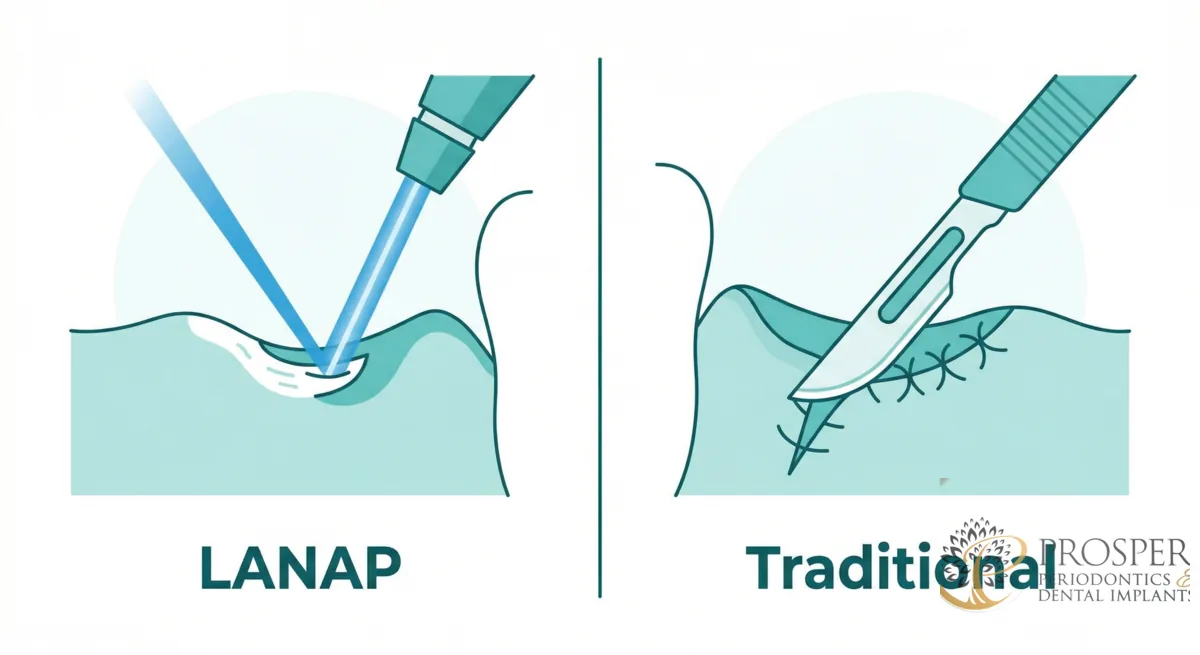
LANAP uses a precise Nd:YAG laser to treat moderate to advanced gum disease (periodontitis) without cutting or sutures, while traditional gum surgery requires a scalpel to cut and suture back the gums. Both procedures treat periodontitis, but they differ significantly in invasiveness, recovery time, and how the body heals afterward.
At Prosper Periodontics & Dental Implants, Dr. Parachuru offers both treatment options and recommends the best approach based on the severity of your gum disease. Here is a detailed comparison to help you understand your options.
How Does Traditional Gum Surgery Work?
Traditional osseous surgery involves cutting the gum tissue with a scalpel, reflecting the gums, and manually removing tartar, infected gum tissue and damaged bone. The gums are then sutured back into place. This procedure has been the gold standard for decades and is effective for advanced periodontitis. However, it involves more post-operative pain, swelling, and a longer recovery period of 2 to 4 weeks.
How Does LANAP Laser Gum Treatment Work?
LANAP uses the PerioLase MVP-7 Nd:YAG laser to selectively remove diseased gum tissue and destroy gum disease causing bacteria without cutting healthy gum tissue. The laser energy also stimulates stem cells in the bone, promoting true periodontal regeneration. Clinical research published in the Journal of Periodontology (Cobb et al., 2006) has demonstrated that this regeneration includes new bone and new connective tissue attachment.
Learn more about our LANAP laser gum treatment procedure.
LANAP vs Traditional Surgery: Side-by-Side Comparison
| Factor | LANAP | Traditional Surgery |
|---|---|---|
| Cutting | No scalpel | Scalpel required |
| Sutures | None needed | Sutures required |
| Pain Level | Minimal | Moderate to significant |
| Recovery Time | 1–2 days | 2–4 weeks |
| Bone Regeneration | Yes (FDA-cleared) | No (resective) |
| Tissue Preservation | Preserves healthy tissue | Removes some healthy tissue |
| FDA Cleared | Yes (510(k) K042648) | Standard of care |
Which Patients Are Better Candidates for LANAP?
LANAP is ideal for patients with moderate to advanced periodontitis who want to avoid the pain and downtime of traditional surgery. It is also an excellent option for patients on blood thinners, those with diabetes, or medically complex patients who may not heal well from conventional surgery.
Does Insurance Cover LANAP?
Most dental insurance plans cover gum surgery procedures (LANAP & Traditional gum surgery). Coverage varies by plan. At Prosper Periodontics, we accept most PPO insurance plans and offer Cherry Financing for affordable monthly payments.
What Does Dr. Parachuru Recommend?
“I recommend LANAP for the majority of patients with moderate to advanced periodontitis, because of its ability to regenerate bone — something traditional surgery simply cannot do,” says Dr. Parachuru“. For patients with specific anatomical challenges, traditional surgery may still be the better option. Every treatment plan is personalized.”
Ready to Explore Your Options?
If you have been diagnosed with moderate to advanced gum disease in Prosper, Celina, Frisco, or the surrounding North Dallas area, schedule a consultation to discuss whether LANAP or traditional surgery is the right choice for your situation. Call (972) 787-1122 or book online.
How Do the Two Procedures Differ in Tissue Trauma and Healing Biology?
The most fundamental difference between LANAP and traditional osseous surgery is what each procedure does to the tissue itself — and that difference drives everything else, from pain levels to how your body heals.
Traditional osseous surgery uses a scalpel to make full-thickness incisions through the gum tissue. The gums are folded back (reflected) to expose the root surface and underlying bone. After cleaning, the gums are repositioned — often at a lower level than before surgery — and sutured closed. This is resective surgery. It works by physically eliminating the pockets rather than regenerating what was lost. The trade-off is that removing tissue is inherently traumatic, produces open wounds, and repositioning the gums lower permanently changes the gum line.
LANAP uses the PerioLase MVP-7 Nd:YAG laser at a specific wavelength (1064nm) with variable pulse duration settings that allow the laser energy to selectively vaporize diseased and pigmented tissue while leaving healthy pink gum tissue undisturbed. No scalpel. No flap. No sutures. The laser also creates a stable fibrin clot at the base of the treated pocket that serves as a biological scaffold for the new tissue to grow against. The difference in post-operative tissue state is dramatic.
Clinical Evidence
New cementum, new alveolar bone, and new periodontal ligament attachment were demonstrated histologically in human subjects treated with the LANAP protocol using the PerioLase MVP-7 laser — Journal of Periodontology (Yukna RA, Carr RL, Evans GH, 2007)
How Do Aesthetic Outcomes Differ Between LANAP and Traditional Surgery?
For many patients, especially those treating front teeth, the aesthetic outcome of treatment is just as important as the clinical outcome — and LANAP has a significant advantage here.
Because traditional osseous surgery requires repositioning the gums at a lower level to eliminate pockets, patients often experience noticeable gum recession after healing. Teeth appear longer. The “black triangles” that form between teeth (loss of the papilla, the triangular gum tissue between teeth) are a known complication. These aesthetic changes are permanent.
LANAP preserves healthy gum tissue. There is no deliberate repositioning of the gumline. Most patients see minimal to no change in gum position after LANAP treatment. In some cases, as the inflammation resolves and the gum tissue tightens against the tooth root, patients see a slight improvement in gum contour. The natural architecture of the smile is maintained.
Patients who already present with gum recession prior to treatment should understand that LANAP treats the disease but does not reverse recession that existed before surgery. A separate evaluation for gum grafting may be appropriate after LANAP healing is complete.
How Do the Candidacy Requirements Differ?
Not every patient with periodontitis is an equal candidate for both procedures, and understanding who benefits most from each approach helps set realistic expectations.
Patients Who Are Strong LANAP Candidates
- Moderate to advanced periodontitis (pockets 5mm to 9mm+)
- Patients on anticoagulants or blood thinners (warfarin, aspirin, clopidogrel) – LANAP carries minimal bleeding risk compared to surgical incisions
- Diabetic patients – the minimally invasive approach reduces physiological stress and LANAP is well-tolerated even with compromised healing
- Patients with a history of cardiac or immune conditions requiring minimal infection risk
- Patients who cannot take significant time off work or daily responsibilities
- Patients who have high dental anxiety or low pain tolerance
- Patients who previously declined treatment due to fear of surgery
Cases Where Traditional Surgery May Still Be Indicated
- Specific anatomical situations such as furcation involvement (bone loss between tooth roots) that requires direct visual access
- Cases requiring bone grafting or guided tissue regeneration at specific sites
- Teeth with complex root anatomy where the laser alone may not fully access all pocket surfaces
- Patients where cost differences are a determining factor and insurance coverage favors traditional surgery
Expert Insight
“I see patients who have been told they need traditional gum surgery and they have been putting it off for years because of the fear. When I explain that LANAP accomplishes the same therapeutic goals without cutting, without sutures, and with a one to two day recovery, most of them wonder why they waited. For medically complex patients - diabetics, patients on blood thinners - LANAP is not just the more comfortable option, it is often the safer one.”
— Dr. Parachuru, Periodontist
How Do Cost and Insurance Coverage Compare?
Both LANAP and traditional osseous surgery are covered by most PPO dental insurance plans under the same periodontal surgery benefit codes, which means your out-of-pocket cost difference may be smaller than you expect.
| Cost Factor | LANAP | Traditional Surgery |
|---|---|---|
| Insurance coverage | Covered by most PPO plans | Covered by most PPO plans |
| Per-quadrant range | Comparable to traditional | Standard surgical rate |
| Time off work | 1 to 2 days (minimal lost income) | 1 to 3 weeks (significant lost income) |
| Prescription costs | Lower (OTC pain management typical) | Higher (stronger Rx pain meds common) |
| Long-term retreatment | Lower risk due to regeneration | Higher recurrence in some studies |
When accounting for the total cost of treatment including lost productivity, prescription costs, and the long-term risk of retreatment, LANAP is cost-competitive with traditional surgery for most patients. Cherry Financing is available at Prosper Periodontics for any remaining balance after insurance.
What Does the Clinical Research Show About LANAP Outcomes?
LANAP has a stronger body of peer-reviewed clinical evidence behind it than any other laser-based periodontal treatment on the market. This is not incidental — the PerioLase MVP-7 received its FDA clearance (K030290, cleared 2004) specifically based on scientific evidence of true periodontal regeneration, a standard that other dental lasers have not met.
The Yukna et al. 2007 study in the Journal of Periodontology is the landmark human histology study that established LANAP’s regenerative credentials. The researchers examined treated sites histologically and found new cementum, new bone, and new periodontal ligament formation — the three components of true periodontal regeneration. Traditional osseous surgery does not produce these histological findings because it is resective, not regenerative.
This distinction matters clinically. Patients treated with LANAP are not just getting shallower pockets — they are getting back some of the attachment apparatus that supports their teeth long-term. The data on pocket depth reduction mirrors this, with typical reductions of 2mm to 4mm at the 6-month re-evaluation in most published trials.
How Do Recovery Timelines Compare Day by Day?
The recovery experience for LANAP versus traditional surgery is not just a matter of degree — it is a fundamentally different type of recovery.
LANAP Recovery at a Glance
- Day 1: Mild soreness, local anesthesia wears off in 2 to 3 hours, OTC ibuprofen typically sufficient
- Day 2: Most patients return to work and normal activity
- Week 1: Soft diet, no brushing directly on treated areas, antimicrobial rinse
- Week 2 to 4: Normal diet and hygiene resume, tissue actively healing
- Months 2 to 6: Bone regeneration occurring beneath the gumline
Traditional Surgery Recovery at a Glance
- Day 1 to 3: Significant swelling, moderate to strong pain requiring prescription pain medication
- Days 4 to 7: Sutures in place, liquid to soft diet required, limited activity
- Week 2: Suture removal, beginning to feel normal
- Weeks 3 to 4: Soft foods, limited hygiene access to surgical sites
- Month 1 to 3: Gum tissue maturing to final position
For the full breakdown of what LANAP recovery looks like week by week and month by month, see our detailed LANAP recovery timeline guide.
If you have been diagnosed with moderate to advanced gum disease and want to understand which approach is right for your specific situation, learn more about LANAP at Prosper Periodontics or explore our full range of periodontal care services. Patients interested in whether their disease has progressed to a point requiring implants can also learn about dental implant options for any teeth that cannot be saved. For a deeper look at whether periodontitis can be stopped before it reaches that stage, read our post on whether gum disease can be reversed.
Related Resources
Learn more about the services and topics discussed in this article:
- laser gum treatment (LANAP)
- periodontal care
- sedation dentistry
- LANAP recovery timeline
- reversing gum disease
Serving Prosper, TX and Surrounding Communities
Prosper Periodontics and Dental Implants proudly serves patients across North Dallas, including: LANAP laser gum treatment in Celina, TX, periodontal care in Frisco, TX. Schedule your appointment today.