
What Is LANAP? The Laser Alternative to Gum Surgery
If you have been told you need gum surgery and you have started searching for an alternative, you have probably already encountered the acronym LANAP. The marketing language around it can feel hard to parse, especially when every dental laser on the market claims some version of “minimally invasive.” This guide cuts through the noise and walks through what LANAP actually is, what makes the PerioLase MVP-7 laser different from other dental lasers, what happens during a treatment visit, and how the science behind it earned the only FDA clearance for true periodontal regeneration. Dr. Praveen Parachuru performs LANAP at Prosper Periodontics using the certified protocol developed and refined by Millennium Dental Technologies.
What Does LANAP Actually Stand For and Mean?
LANAP is the Laser-Assisted New Attachment Procedure, and it is the only FDA-cleared laser protocol shown in human histological studies to support true periodontal regeneration, including new bone, new periodontal ligament, and new cementum.
The name itself contains the clinical claim that separates LANAP from every other laser-based gum treatment. “New attachment” is a specific histological term in periodontics. It means that after treatment, the tooth root has reattached to surrounding tissue through the same three components that exist in healthy periodontium: new bone (alveolar bone), new ligament (periodontal ligament fibers inserting into the root), and new cementum (the layer covering the root that anchors those fibers). Other periodontal therapies, including traditional flap surgery, can reduce pocket depth and resolve infection, but they generally heal by what is called a long junctional epithelium. That is repair, not regeneration.
The distinction is not academic. Repair restores function but leaves the tooth-to-bone interface less robust than the original. Regeneration restores something closer to the original architecture. This is why LANAP carries a 510(k) clearance from the FDA specifically for “cementum-mediated periodontal regeneration with new attachment.” No other dental laser holds this designation.
How Does the PerioLase MVP-7 Differ From Other Dental Lasers?
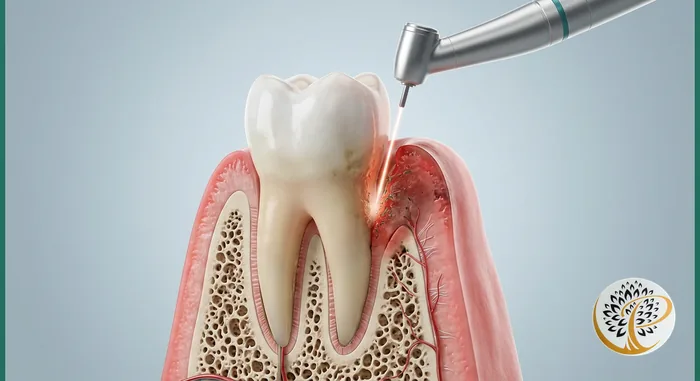
The PerioLase MVP-7 is a free-running pulsed Nd:YAG laser with a 1064-nanometer wavelength and seven distinct pulse-duration settings, and it is the only laser designed and FDA-cleared for the LANAP protocol.
Several types of lasers are marketed for dental and periodontal use, and they are not interchangeable. Diode lasers (810nm to 980nm) are inexpensive, widely available, and useful for soft-tissue surgery and bacterial reduction, but they do not have FDA clearance for periodontal regeneration. Erbium lasers and the Waterlase system (Er,Cr:YSGG) cut hard and soft tissue using water-energized energy, which is well-suited for cavity preparation and some surgical procedures, but they likewise do not hold FDA clearance for true periodontal regeneration. CO2 lasers are used for soft-tissue procedures and have no LANAP indication.
The PerioLase MVP-7 occupies a unique position because of its specific wavelength behavior. The 1064nm Nd:YAG energy passes through healthy, lightly pigmented gum tissue with minimal interaction and is preferentially absorbed by the dark pigments associated with diseased and inflamed tissue, including the porphyrin compounds in periodontal pathogens. This selective absorption means the laser targets exactly what needs to be removed while sparing the healthy tissue that needs to remain. The variable pulse durations allow the operator to tune the laser for tissue removal, hemostasis, or final-pass thermal effects that promote a stable fibrin clot at the base of the pocket.
That fibrin clot is one of the under-discussed reasons LANAP works. Periodontal regeneration depends on stabilizing the wound so that bone and ligament progenitor cells can populate the defect without being outcompeted by faster-growing epithelium. The laser-induced clot acts as a biological scaffold during the critical first weeks of healing.
What Happens Step by Step During a LANAP Treatment Visit?
A LANAP appointment follows a defined seven-step protocol that begins with measurement, includes two laser passes around each tooth, incorporates ultrasonic root cleaning, and ends with bite adjustment.
Step one is the periodontal probing. Each pocket around each treated tooth is measured in millimeters and recorded. The depth and bleeding pattern guide where the laser energy is focused. Patients who have been through traditional periodontal surgery recognize this measurement step from any thorough periodontal exam.
Step two is local anesthesia. LANAP is not painless because pocket depth measurement and root surface contact remain uncomfortable in inflamed tissue, so the treatment area is numbed with local anesthetic the same way it would be for any dental procedure. Patients with significant anxiety can request additional sedation, including the options described in our sedation dentistry guide.
Step three is the first laser pass. A small fiber-optic tip about the diameter of three human hairs is inserted into each pocket and moved along the root surface. The laser energy at this stage is tuned to vaporize diseased epithelial lining and reduce the bacterial load. Healthy gum tissue is largely unaffected because of the wavelength selectivity discussed above.
Step four is ultrasonic root debridement. With the diseased lining removed, the calculus and biofilm on the root surface are dislodged using piezoelectric or ultrasonic instrumentation. Removing this hard deposit is what allows the body to reattach to a clean root.
Step five is the second laser pass. The laser is retuned to a longer pulse duration that creates the stable fibrin clot at the base of the pocket. This is the regenerative pass. It compacts the clot, seals the pocket against bacterial recolonization, and sets up the biological environment for new cementum and new bone to form over the months that follow.
Step six is occlusal adjustment. The bite is checked and any teeth contributing excessive force on inflamed roots are smoothed so that the healing tissue is not disrupted by chewing pressure. Bruxism that goes unaddressed undermines outcomes regardless of how well the tissue treatment goes.
Step seven is post-operative instruction. You go home with specific guidance on rinsing, hygiene, and the soft-food window. There are no sutures to remove, no flap to monitor, and no prescription pain medication for most patients. The detail of week-by-week healing is covered in our LANAP recovery timeline.
Why Does the Phrase “No Cut, No Stitch” Matter Clinically?
Avoiding incisions is not just a comfort feature. It changes how the gum tissue heals, what the gumline looks like afterward, and how much bleeding and infection risk accompanies the procedure.
Traditional flap surgery cuts through the gum, reflects it away from the tooth, cleans the underlying root and bone, and sutures the tissue back, often at a lower position than where it started. The repositioning is intentional. It is how the surgeon eliminates the deep pockets that harbor bacteria. The trade-off is permanent gum recession at the treated sites. Teeth look longer afterward. The triangular gum tissue between teeth (the papilla) can be lost, leaving small dark spaces sometimes called black triangles. These changes are aesthetic costs that many patients accept because the alternative is progressive bone loss.
LANAP does not reposition the gumline. The pockets shrink because the diseased tissue at the bottom is removed and the body reattaches through regeneration. The visible architecture of your smile stays substantially the same. For patients with disease in the front of the mouth, this preservation can be the difference between accepting treatment and continuing to delay it. Patients who already have visible recession should understand that LANAP treats the active disease but does not reverse pre-existing recession; that may require a separate gum graft evaluation after healing is complete.
The bleeding and infection picture is also different. There is no open wound. There is no full-thickness incision to track infection through. Patients on anticoagulants tolerate LANAP particularly well because there is no surgical bleeding to manage. Diabetic patients tolerate it well because there is no large wound to heal in a metabolic environment that already slows healing. The minimally invasive design widens the candidate pool meaningfully.
What Does the FDA Clearance Actually Cover?
The PerioLase MVP-7 holds 510(k) clearance specifically for periodontal regeneration including new attachment and new bone formation, and that clearance is the strict regulatory standard that other dental lasers have not met.
FDA clearance language for medical devices is precise. Most dental lasers are cleared for “incision, excision, ablation, vaporization, and coagulation of soft tissue.” That clearance language allows the device to cut and ablate tissue. It does not make any claim about regenerating bone or restoring periodontal attachment. Lasers cleared under that general category include diodes, erbium lasers, and CO2 lasers, and most of them are excellent for the procedures they are designed for.
The PerioLase MVP-7 holds the additional, narrower clearance for “cementum-mediated new attachment to the root surface in the absence of long junctional epithelium.” That language is the regenerative claim. It was supported by histological evidence in human subjects, including the often-cited Yukna et al. study published in the International Journal of Periodontics and Restorative Dentistry in 2007. The histology showed new cementum, new ligament, and new bone in tissue samples taken from human teeth treated with the LANAP protocol. No other laser-based periodontal therapy has cleared this regulatory bar.
When you read a marketing page that uses words like “laser gum surgery” or “laser-assisted periodontal therapy,” it is worth asking what specific laser is being used and what the clearance covers. Lasers without LANAP clearance can still help with bacterial reduction and minor soft-tissue work, but the regenerative claim does not transfer.
Who Is a Good Candidate for LANAP?
LANAP is indicated for patients with moderate to advanced periodontitis, particularly those with pockets in the four-to-nine millimeter range, and the protocol works well across most adult age groups and many medically complex profiles.
The strongest candidates are patients with generalized moderate to advanced chronic periodontitis. Pocket depths of four to nine millimeters with bleeding on probing and attachment loss are the textbook indication. Patients who are on the fence between scaling and root planing alone and full surgical intervention are often the ones who benefit most from LANAP, because it is appropriate where SRP would be insufficient but where they would prefer to avoid traditional flap surgery.
Medically complex patients are an important LANAP population. Patients on anticoagulants such as warfarin, apixaban, clopidogrel, or daily aspirin tolerate the protocol well because there is no surgical incision. Diabetic patients with reasonable glucose control benefit from the lower physiological stress and lower infection risk relative to flap surgery. Patients with cardiac history, immune conditions, or healing disorders fit the same logic. The bidirectional connection between gum health and systemic disease is covered in our companion post on the link between gum disease, heart disease, and diabetes.
Patients with high dental anxiety, low pain tolerance, or a history of declining recommended periodontal surgery often find LANAP to be the entry point that finally works for them. The recovery profile is fundamentally different, and many patients comment that the appointment itself was less involved than they expected.
A few situations call for traditional flap surgery instead of or in addition to LANAP. Severe furcation involvement (bone loss between the roots of multi-rooted teeth) sometimes requires direct visual access. Cases requiring significant bone grafting or guided tissue regeneration at specific sites may be better served by an open approach. Patients with very specific anatomical situations are evaluated individually, and Dr. Parachuru is candid when traditional surgery is the better option.
Is LANAP a Cure for Gum Disease?
LANAP is highly effective at stopping active periodontitis and supporting regeneration of lost attachment, but periodontitis is a chronic condition, and long-term outcomes depend on ongoing maintenance the same way any chronic condition does.
It is more accurate to think of LANAP as a powerful intervention that resets the periodontal environment than to think of it as a one-time cure. Studies suggest that pocket depth reductions of two to four millimeters are typical at the six-month re-evaluation, with bleeding-on-probing reductions of fifty to seventy percent. These outcomes are clinically significant and durable when patients follow through with the maintenance protocol.
Maintenance after LANAP looks similar to maintenance after any periodontal therapy. Three- or four-month periodontal maintenance visits are typical for the first year or two, transitioning to a six-month interval as tissue stability is confirmed. Home care that emphasizes interdental cleaning, soft-bristled brushing technique, and antimicrobial rinsing as appropriate is part of the long-term plan. Patients who skip maintenance for years lose ground regardless of how well the original treatment went.
The early-warning signs to watch for over the long term are the same ones that brought you in initially. Bleeding when you brush or floss, swollen or tender gums, and persistent bad breath are the early indicators of recurring disease. Our post on the signs of gum disease covers what to monitor at home, and our reversing gum disease guide walks through what is and is not reversible.
Ready to Restore Your Gum Health?
If you have been diagnosed with moderate to advanced periodontitis and want to understand whether LANAP is the right approach for your situation, the next step is a consultation that includes a comprehensive periodontal exam, pocket charting, and a transparent discussion of treatment options. Dr. Parachuru completed his periodontics certificate at the University of Minnesota alongside a PhD in Immunology, which means LANAP candidates at Prosper Periodontics are evaluated by a clinician who understands both the laser physics and the underlying tissue biology that drives long-term outcomes. We see patients from Prosper, Frisco, McKinney, Celina, and Aubrey at our office at 2300 E Prosper Trail Suite #20.
To schedule, call (972) 787-1122 or request a consultation online. You can also learn more about our complete protocol on the LANAP service page or compare options on our LANAP vs traditional gum surgery guide.